

author
Ahmed Balaha
author

Share

Japan’s largest e-commerce platform will include Ripple XRP in its payments suite on April 15, 2026, listing it in the Rakuten Wallet for instant trading and connecting it to Rakuten Pay, the app that 44 million users already use to buy coffee, groceries and bullet train tickets.
The address number is large enough for them.
The analytical question is trickier: Does XRP within a closed loyalty ecosystem constitute retail adoption, or is this a product feature update that happens to use cryptocurrency infrastructure that most users will never see?
- Integration date: XRP will launch on the Rakuten Wallet for spot trading on April 15, 2026, with XLM, DOGE, SHIB, and TON listed alongside it.
- User scale: Rakuten Pay has 44 million users; The broader Rakuten ecosystem in Japan covers more than 100 million member IDs.
- Mechanism: Users convert Rakuten Points directly into XRP, then fund Rakuten Cash – which can be used at over 5 million merchant locations – meaning XRP acts as a bridge asset, rather than as a consumer token held directly for most transactions.
- Points pool: More than 3 trillion Rakuten points, worth an estimated $23 billion, are eligible for transfer – creating a large but closed source of potential demand for XRP.
- Regulatory basis: Rakuten Wallet operates under an FSA license and JVCEA membership, providing compliance cover for the offering in one of the most regulated cryptocurrency jurisdictions in the world.
- What it doesn’t do: This is not an open XRP wallet; It does not give users direct custody of XRP outside of the Rakuten ecosystem, and merchants receive fiat currencies — not XRP — at the point of sale.
- He watches: Whether Rakuten Bank’s planned FinTech integration (marked at its AGM on March 27, 2026) enables seamless conversion from fiat currencies to XRP across its 17 million bank accounts by Q3 2026.
How the Rakuten-Ripple XRP integration actually works – and what it doesn’t
Rakuten Points are not crypto assets. It’s a special loyalty currency issued by Rakuten at a rate of approximately 1 point for every 1 yen spent across its ecosystem — shopping, travel, streaming, and banking.
The company issued nearly 620 billion points in 2022 alone. The total outstanding balance is more than 3 trillion points, equivalent to approximately US$23 billion at current exchange rates. That’s a lot of locked down consumer value.
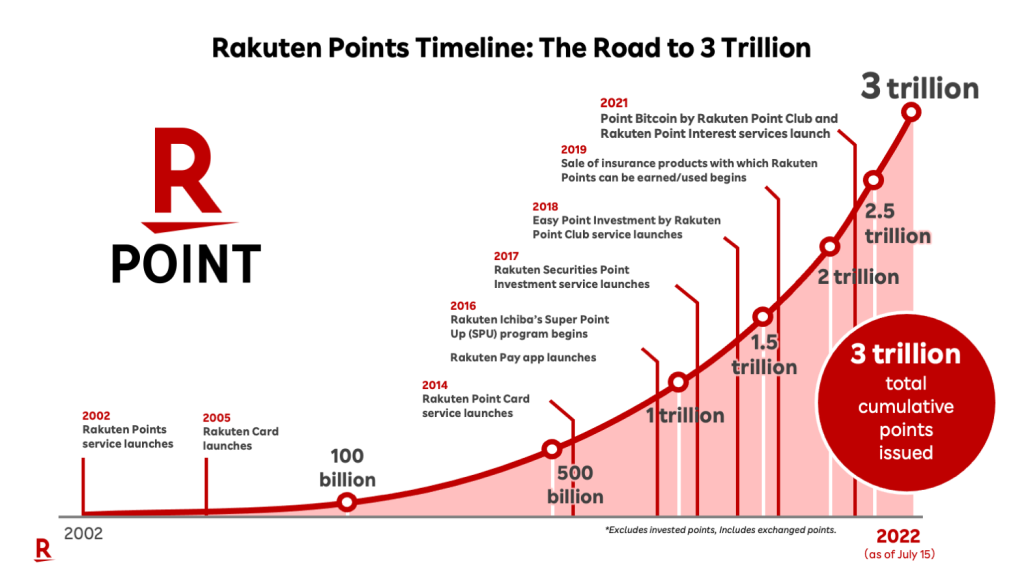
What the April 15 integration does is open up a conversion funnel: users can take those points, convert them to XRP through Rakuten Wallet, and then upload the resulting balance to Rakuten Cash, the platform’s e-money layer, for spending at more than 5 million merchant locations.
The Rakuten Pay app handles the front end. Rakuten Wallet, an FSA-licensed and JVCEA-registered exchange, handles the backend for cryptocurrencies.
This is the important part of how the adoption title reads: Merchants receive fiat currencies. When a user pays with Rakuten Cash funded with XRP, the conversion to yen happens in the background.
The retailer has no exposure to Ripple XRP. The user, in most cases, interacts with the flow of points to payment that is routed through the XRP infrastructure. This is not the same as the 44 million people who buy and hold XRP.
Japan’s organizational structure makes this structure possible. The Financial Services Authority (FSA) has created a clear legal classification for XRP as a cryptocurrency, distinct from securities, a framework within which Japan’s evolving cryptocurrency regulatory environment This has been built up through successive amendments to the Payment Services Act.
Rakuten is not a leader on the regulatory path; It’s a move that SBI Holdings and others have already cleared.
Liquidchain targets early upside while XRP tests key levels
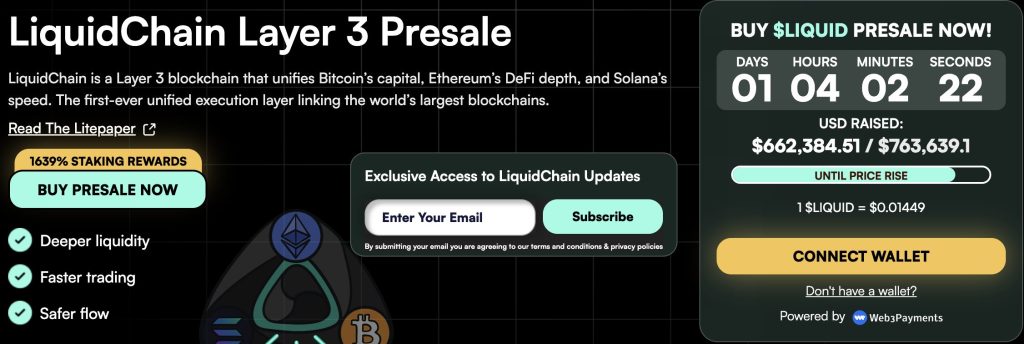
Liquid Chain(LQC) One project that is drawing attention in this context is a layer 3 execution environment designed to pool liquidity across Ethereum and its backlog ecosystem, with a technical architecture that specifically targets throughput bottlenecks that Glamsterdam addresses in the core layer.
The pre-sale has raised more than $660,000 at the current token price of $0.0147, with betting bonuses available for the first participants.
What fundamentally sets the project apart is unified liquidity routing across sharded L2 environments, a structural issue that becomes increasingly important as the Ethereum stack ecosystem expands post-Glamsterdam. Pre-sale investments carry real risks, and this is an early stage tier 3 infrastructure project with significant implementation uncertainty. DYOR applies unconditionally.
Explore the Liquidchain preview here


