
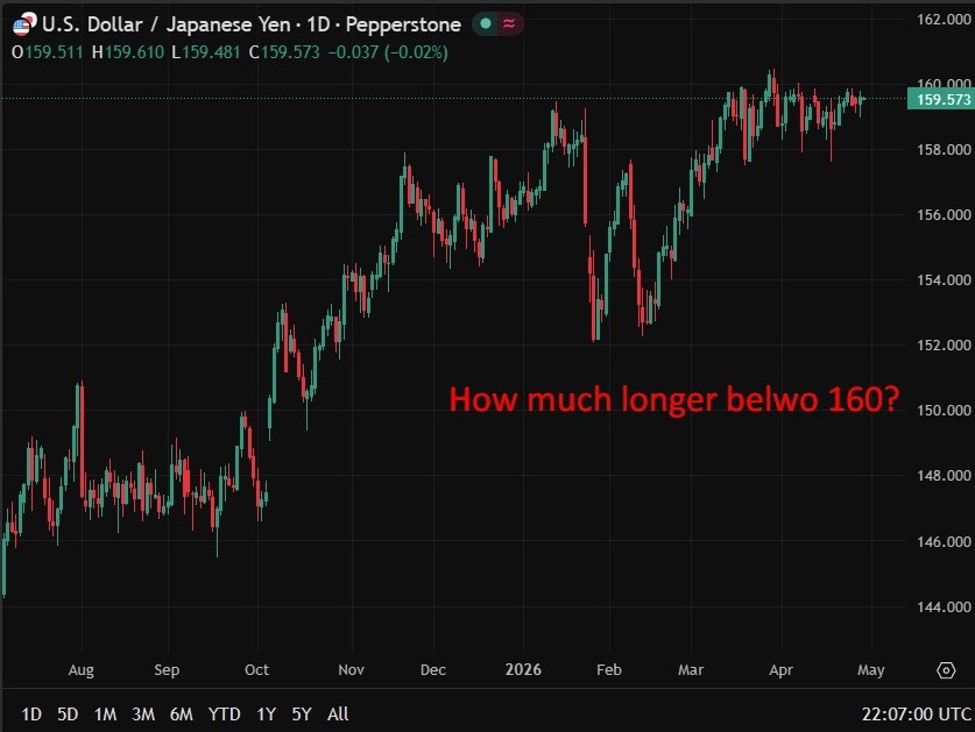
This headline, “BoJ Can’t Save the Yen,” is a jibe at ING, straight to the point.
ING warns that the Bank of Japan cannot rescue the yen, sees USD/JPY challenging the 2024 high at 162 and signals an external risk that authorities will postpone intervention until the 165 area.
summary:
- USD/JPY falls modestly after hardening opposition at Tuesday’s Bank of Japan meeting, but ING says case for continued yen strength remains unproven
- ING says the Bank of Japan was already following an accommodative policy before the Middle East crisis and that its slow pace of tightening threatens to push real interest rates into negative territory.
- A Bank of Japan hike of 25 basis points in June or July, taking the interest rate to 1.00%, would still leave real interest rates negative given core inflation expectations above 2%.
- ING expects upward pressure on USD/JPY to continue in the near term, with increasing dollar stability and the possibility of Fed hawkishness adding to the headwinds for the yen.
- The bank sees USD/JPY challenging the 2024 high at 162, with an external risk of authorities intervening until the 165 area.
- Intervention in the Japanese currency market is seen as less effective than in 2024, with the volume of speculative yen short positions currently at about half the volume that led to the short squeeze in the summer of 2024.
- ING notes that the yen remains too cheap to hedge, limiting its appeal even for positive investors in Japanese stocks.
ING warned that the Bank of Japan is not in a position to halt the yen’s decline, arguing that the central bank’s cautious approach to monetary policy tightening leaves the currency increasingly exposed as rising energy prices push real interest rates deeper into negative territory.
The note, published after the Bank of Japan’s policy meeting on Tuesday, acknowledged the modest decline in USD/JPY following hard-line opposition among board members, but dismissed it as insufficient to change the broader picture. ING’s main argument is that currency markets are now primarily focused on real interest rates and the willingness of central banks to defend their economies from inflation. By this measure, the Bank of Japan is falling short of achieving this.
The bank notes that Japanese monetary policy was already accommodative before the outbreak of the conflict in the Middle East, and that the central bank’s slowness in raising interest rates threatens to exacerbate the problem. Even a 25 basis point rate hike at the June or July meeting, which would raise interest rates to 1.00%, would do little to save the yen. With core inflation expected to remain above 2% over the BOJ’s forecast horizon, such a move would still leave real interest rates in negative territory. On the other hand, the Bank of Japan is bracing for the shock of deteriorating terms of trade as a result of rising energy costs, an uncomfortable situation for a major energy importing economy.
ING makes a comparison with the energy shock of 2022, but notes that the current episode has been smaller in magnitude so far. However, it expects negative pressure to dominate the yen and other Asian energy-importing currencies during the year, unless a quick solution is found in the Gulf region.
As for the near-term trend of USD/JPY, ING expects upward pressure to continue. The dollar’s stability over the current quarter, combined with the possibility of a hawkish Fed, keeps the pair biased higher. ING sees USD/JPY challenging its 2024 peak at 162, with an external risk of Japanese authorities delaying intervention until the 165 area in order to maximize the impact.
This calculus is complicated by positioning. The 2024 episode, in which Japanese authorities sold about $100 billion to trigger a major short squeeze, was effective in part because speculative short positions in the yen were so large. Today, these deals are roughly half their size, which ING says will limit the effectiveness and timing of any future intervention.
With negative real yields, deteriorating terms of trade, and policymakers’ reluctance to act, ING concluded that the yen offers little appeal to currency investors. The fact that hedging remains cheap makes it easier for equity investors to avoid currency risk, but this dynamic itself reflects how little confidence markets have in the yen’s recovery.
—
The ING note carries clear bearish implications for the yen. With real interest rates very negative and the Bank of Japan unwilling to tighten policy aggressively enough to offset higher inflation, the path of least resistance for USD/JPY is higher. A potentially hawkish Fed in the near term adds further upward pressure on the pair. Japanese intervention remains unpredictable, but ING says its effectiveness has diminished as yen short positions are roughly half the size they were before the historic intervention in 2024. This reduces the scope for an aggressive short squeeze.
For broader Asian currency markets, the note highlights that energy-importing economies in the region face similar headwinds in terms of trade, keeping pressure on currencies outside the yen. Equity investors with Japanese exposure may find the yen cheap to hedge, but this in itself indicates limited confidence in any near-term recovery.


