

Listen to the audio version of this article (generated by artificial intelligence).
Iran halts negotiations… How high can oil go?… The 3 red flags of Jonathan Rose’s IPO… Elizabeth Warren pushes AI taxes and increases capital gains taxes… Data that undermines her jobs argument…
As I write on Monday around lunch, US oil prices are up 7%, with WTI jumping to nearly $94 a barrel and Brent crude approaching $97 a barrel.
The price action was driven by news that Tehran has halted negotiations with the United States and threatened to completely close the Strait of Hormuz in response to the escalating Israeli ground offensive in Lebanon.
The headline comes at a fragile moment in the Middle East. Despite an uneasy ceasefire that took effect in early April, US warplanes bombed Iranian radar and drone facilities on Qeshm Island over the weekend. Meanwhile, Iran launched missiles and drones at Kuwait. Both sides claimed that the other fired first.
Despite what appears to be a deterioration in the geopolitical situation, President Trump posted yesterday on Truth Social:
Iran really wants to reach an agreement…
Just sit back and relax, everything will work out well in the end.
It is not clear whether this optimism is justified. Axios It was reported over the weekend that Trump requested several amendments to the draft agreement his envoys reached with Iranian officials. Clearly, nuclear commitments and the scope of sanctions relief are key issues.
With oil prices rising this morning, markets are pricing uncertainty more than reassurance. The range of results here is wide.
Head of Geopolitical Analysis at Rystad Energy said: CNBC A complete collapse of the talks – with fighting resuming in earnest – could push Brent to $180 a barrel by August. On the other hand, a comprehensive agreement could see prices fall towards $70 by the end of the year.
Remarkably, this strait – barely 21 miles wide at its narrowest points – largely controls the fate of global energy markets, inflation expectations, and economic growth across three continents.
We will keep you updated.
“They robbed us. That’s the only way I can put it.”
This is our trading expert Jonathan Rose, in reference to what happened with… figma company (fig) The IPO – which we detailed on Friday digest.
Here’s Jonathan’s quick summary if you missed it:
There was a performance-based trigger that almost no one knew about.
The stock opened 158% above the threshold, and so the catalyst kicked in on day one. After 36 days, people who understood the structure were selling at $80.
Eight months later, Figma’s stock price reached $22 — down 81% from the peak and 33% below its IPO price itself.
This structure was not an accident. It was a playbook.
This story reflects a saying I heard somewhere along the way…
“IPO” does not stand for “initial public offering,” but rather “initial public offering.” unloading“- the time when insiders dispose of their shares to the unsuspecting public.
An IPO wave is on the way – on a scale we’ve never seen before. SpaceX, Anthropic, and OpenAI represent over $3 trillion in combined valuations coming to market, and each is structured by the same investment banks using the same mechanisms.
Given this, Jonathan has just pointed out five warning signs that a deal is designed for insiders, not you. I want to share with you three.
Three IPO red flags to watch for
The first thing to check is the float. If less than 10% of the stock is offered, Jonathan says be careful:
Small floats create artificial scarcity. They inflate the pop on the first day. They give insiders more shares to sell at secondary lock-up expiration periods.
Second, ignore the boast about “oversubscription.” Back to Jonathan:
A heavily oversubscribed deal that is priced lower than it should be is obviously a deal that was intentionally underpriced to make a splash.
Third – and this is what almost no one does – look on the S-1 for “early release status” or “performance-based release.”
Here’s Jonathan on what to look for:
If the lock issues additional shares at a price 25% above the IPO, and the company prices low enough to warrant incentive, then you are looking at a Figma structure.
This is part of your defensive playbook – but what about offense?
Jonathan recommends investors buy the IPO family, not the headline.
Every AI IPO on this track has publicly traded proxies that you can own today. The logic of family ownership works in two ways…
These companies have direct equity stakes that rise in value as IPO prices rise, and when Wall Street starts assigning massive valuations to a sector, public peer companies are repriced as well — analysts are forced to update their comparisons overnight.
At SpaceX Alphabet Company (Google)which holds a 6.11% stake — an exposure that suddenly becomes visible once SpaceX begins trading publicly. Anthropic has Amazon.com Inc. (Amzn) and Nvidia company (NVDA) As major investors. OpenAI has Microsoft Corporation (MSFT) As its cloud partner and stock.
No lockout risk. There is no allocation lottery. There is no premium built on intentionally restricted float.
Jonathan has taken this a step further
His unusual trading activity scanner — which identifies concentrated institutional positions before the crowds arrive — is now paired with veteran trader Mark Chaikin’s Institutional Money Flow Index.
When both indicators confirm the same name, that is Convergence operator. It’s a powerful way to find the most attractive stock opportunities around huge market events like IPOs before the bell rings.
Last week, the two experts went live to learn how this affinity trigger works — and they shared specific settings that are already flashing today.
Click here to watch the free replay.
Bottom line: $3 trillion in AI “initial public dumps” is on the way. Be smart about how you play it.
Now, all the money being made – whether from IPOs or large-scale AI trading – is widening the wealth gap in America. This produces the exact political response I predicted in January…
At the beginning of the year, while our analysts were revealing their market forecasts for 2026, I prepared one of my own.
This year will bring a wave of controversial new legislative proposals targeting investment wealth – proposals that may not pass immediately, but will introduce a new layer of political risk that investors will have to take into account.
Behind my forecast was our expanding K-shaped economy, where Americans who own assets are getting richer, while those who are not watching inflation erode their purchasing power.
Data released by the Federal Reserve show that in April, the gap between these two groups hit a record high…
The top 1% of households now own 31.9% of total wealth in the United States. This is the highest share on record since the Fed began tracking it in 1989. Meanwhile, the bottom 50% own just 2.5% of the country’s wealth.
History shows that large and persistent economic divisions cannot be contained. Over time, they tend to produce political responses. This was the basis for my expectations.
In this context, let’s turn to Senator Elizabeth Warren’s (D-Mass.) op-ed published in time Last Wednesday. These are selected quotes:
- It’s time to tax AI and invest in people…
- Taxing AI is one way we ensure that gains from AI benefit all Americans…
- We need to level the playing field by increasing corporate and capital gains taxes.
- There’s no denying that AI is already changing the job market…
Now, we can analyze Warren’s article from all angles. But let’s focus on the last point regarding the labor market…
What is the truth about the loss of artificial intelligence jobs?
If you are for a long time digest Reader, you know I’ve spent years pointing out the apocalyptic risk of AI-led jobs. The early data and commentary from AI experts pointing in this direction was hard to ignore, and I’ve never been shy about sharing it.
But there is one thing I have always tried to be honest about, even when new evidence contradicts old assumptions. And recently, that’s exactly what’s been happening.
So, let’s look at the actual data.
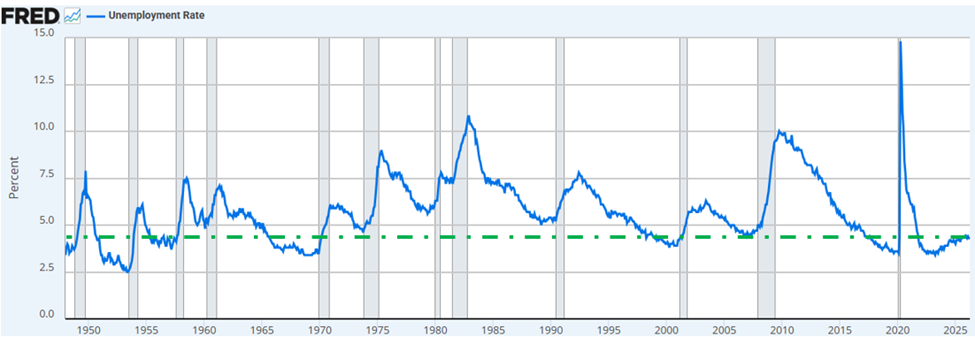
First, we have been three years into the AI era, yet the national unemployment rate remains at 4.3%.
As you can see below, this is one of the lowest rates on record dating back to 1950.
Second, as I covered last Wednesday digestFederal Reserve data on unemployment among college graduates and underemployment show that both measures are roughly in line with their 30-year averages.
For example, here’s the underemployment rate for recent graduates and college graduates dating back to 1990 as a reminder.
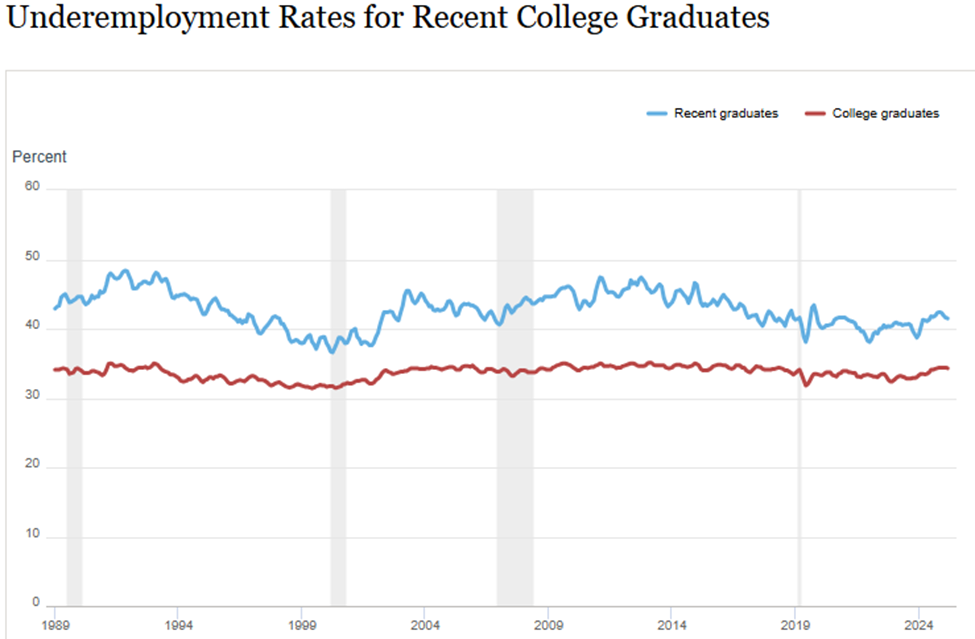
These statistics do not support the picture of crisis that Warren suggests, or the recent headlines about “graduation booing” — students booing commencement speakers who mentioned artificial intelligence — even as basic employment data remains strong.
Third, let’s take a look at what the actual job posting data shows – starting with the report from Citadel Securities that I featured in last Friday’s issue of the Citadel Securities magazine. Investing from within.
The short version: Employment in many industries exposed to AI is not collapsing and, in some cases, accelerating.
For example, the chart below shows a dotted vertical line labeled “Reversal in Software Employment” around May 2025 — just as AI capabilities were dramatically accelerating.
Employment of software engineers has soared since then, now rising 18% from that tipping point. The profession most exposed to AI in the economy is seeing some of the fastest employment growth.
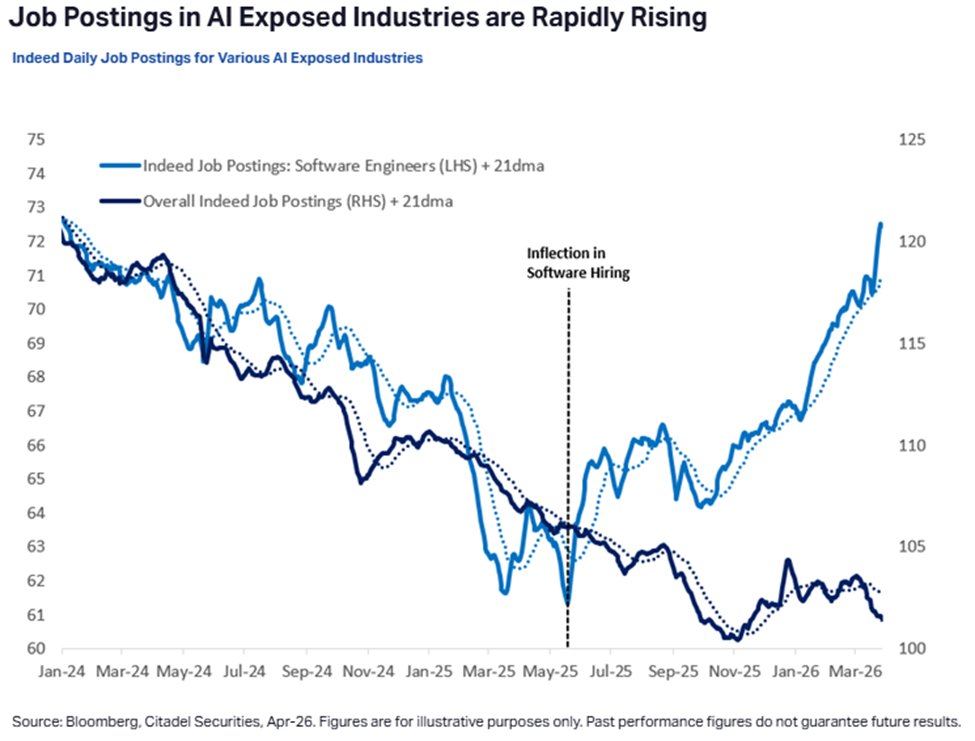
If AI is indeed replacing knowledge workers on a large scale, this is not the kind of graph we expect to see.
Even when layoffs are real, the story is complicated
The technology sector has seen heavy layoffs in recent months. But there’s more to it than the headlines…
Remember the Swedish fintech giant “buy now, pay later”. Klarna (clear)?
It reduced its workforce by 22%, and boasted that its AI chatbots had the potential to take on the work of 700 customer service agents and marketing staff.
Well, after facing a decline in service quality and customer trust, the company rolled back deep cuts and began a hiring drive to bring human employees back into customer support roles.
Even Sam Altman and Dario Amodei, the company’s CEOs OpenAI and Anthropic They are retreating from their previous pessimistic forecasts about job cuts.
here luck From last week:
Altman said he was “completely wrong” about the economic impact of AI, a reversal of his warnings in June 2025 that entry-level roles were at serious risk.
Amodei, who once claimed that AI could eliminate 50% of white-collar jobs, now says automation may actually expand the work people do.
Interesting timing as these companies prepare to go public…
Now, I’m not saying that displacement won’t eventually accelerate — but the current data simply isn’t there, and experts are radically changing their view.
If you are Investing from within subscriber, Click here to log in And read the full analysis and article from Citadel. You’ll get a better idea of what’s really going on – and how to position your investment portfolio.
If you haven’t yet Investing from within Common, this is a service where I interview our analysts, break down research from major Wall Street firms, and translate it all into portfolio risks and implications that are disproportionate to digest. Click here to learn more.
Where does it all end?
Data today shows that the job loss narrative is far ahead of the actual job loss numbers.
In other words, although it may change in the future, Elizabeth Warren’s assertion that “there’s no denying that AI is already changing the job market” is wrong – there is too much to deny.
But when it comes to the consequences for your investment portfolio, they don’t need to be right — they just need to be convincing.
So, where does this leave us today?
Stay long – but eyes open to public sentiment and political framing.
I wish you a good evening,
Jeff Remsburg


