


author
Ahmed Barakat
author

Share

Senator Bill Hagerty told FOX Business on June 18 that he remains hopeful that the Digital Asset Market Clarity Act can clear the Senate before the July 4 recess, even while acknowledging that the bill may pass after Independence Day.
His optimism runs up against a wall of procedural reality: The Clarity Act has yet to get a vote in the Senate, still needs to pass the 60-vote threshold, and requires reconciling two competing texts from Senate committees before any House-Senate alignment can begin.
The gap between Hagerty’s stated hope and the legislative calendar is measurable. Congress has less than 9 business days before its July 4 recess.
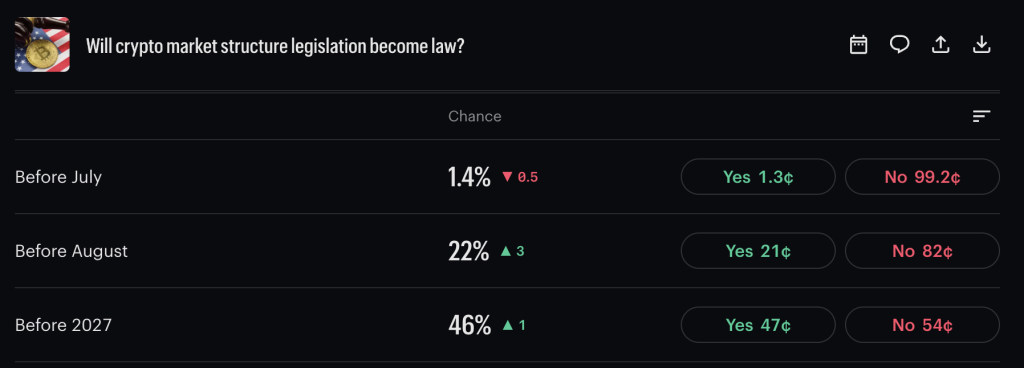
Calci prediction markets are currently pricing Senate passage by August 2026 at roughly 22%, which reflects the broader analyst read: Passage this summer is possible, passage before July 4 is a different question entirely.
The House passed its version of the bill on July 17, 2025, by a vote of 294 to 134, a bipartisan result that gave the legislation real momentum.
The Senate Banking Committee followed with a 15-9 vote on May 14, 2026, to advance the bill to the Senate legislative calendar. This step made ground action procedurally possible. It did not make it imminent.
In essence, the cryptocurrency legislation would create a CFTC-led regulatory regime for digital commodities — classifying assets like Bitcoin and Ethereum under CFTC oversight while assigning narrower jurisdiction to the SEC over certain brokerage, trading, and exchange activities.
This division of power is the central policy structure of the bill, and it carries real market implications: Standard Chartered has estimated that passage could unlock $8 billion in XRP ETF flows alone, based on the regulatory certainty the framework would provide.
Three hurdles between the Clarity ACT bill and a Senate vote
60 votes The threshold is the first hard constraint. The Senate Banking Committee’s 15-9 approval shows support at the committee level, but turning that to 60 votes would require bipartisan approval, which has not yet been secured publicly.
This threshold does not change regardless of how lawmakers and industry agree with the substance of the bill.
The second obstacle is reconciliation between the committees. The Senate Banking Committee text and a separate Senate Agriculture Committee text should be combined into one floor-ready bill.
These two committees share jurisdiction over the divided CFTC-SEC authority at the heart of the legislation, and any amendment must be submitted to the director to resolve their differences before a vote is scheduled. This step alone usually takes weeks of staff negotiations.
The third obstacle, and the most active one currently, is the dispute over moral judgments. David Nagy, managing director and portfolio manager at Arca, said after meetings with Senate offices that lawmakers and industry participants are about 80-85% in agreement on the substance of the bill, and that the stablecoin returns provisions, despite ongoing criticism from JPMorgan CEO Jamie Dimon, are no longer the primary point of friction.
What remains is a conflict of interest dispute over how to prevent senior government officials from engaging in cryptocurrency-related business activities while in office.
Senator Kirsten Gillibrand reportedly conditioned her support on explicit ethics language barring top officials from profiting from cryptocurrency holdings, warning against withholding votes without that provision.
This is not a simple wording problem, but rather a named senator with influence over the 60 vote calculations making a specific requirement. Nagy described the remaining dispute as a political and executive question rather than a dispute over market structure, but political questions are precisely the kind that disrupt floor scheduling.
A coalition of gaming associations, tribal governments and labor unions separately He lobbied the Senate to include language prohibiting prediction markets from offering sporting event and casino contracts Under the CLARITY Act framework, there is another controversial provision that adds to the burden of settlement before any vote is applicable.


