

Debates over Bitcoin governance are heating up again, and this time Michael Saylor has entered the conversation with a lengthy critique of BIP 110. Rather than focusing on price or market cycles, Saylor says the proposal could radically change how Bitcoin evolves by introducing consensus rules that restrict currently valid transactions.
His argument is not that every non-financial inscription or request deserves protection. Instead, Bitcoin’s consensus layer should not be used to determine legitimate transactions and pay acceptable fees.
Saylor questions consensus rule changes
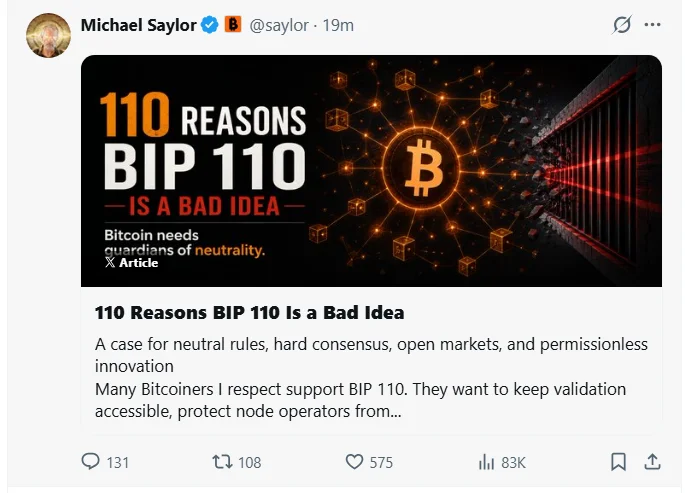
BIP 110, known as Softfork Temporary Data, proposes introducing several temporary consensus constraints for a period of approximately one year. according to Sailorthe proposal would limit multiple transaction and scripting features during deployment through a modified activation process that lowers the threshold for miner signals compared to previous Bitcoin soft forks.
Although existing UTXOs created prior to activation will not be affected, Saylor says the proposal would still remove transaction functionality that is currently considered valid and sets a precedent for future use cases to be restricted by consensus rather than market forces.

He repeatedly stresses that his criticism is aimed at the proposal itself rather than its authors, acknowledging that proponents are trying to address real concerns about contract costs, transaction efficiency, and Bitcoin’s role as sound money.
Neutral rules versus protocol constraints
The main theme of Saylor’s memo is Bitcoin’s neutrality principle. According to him, Bitcoin cannot distinguish between whether transaction data represents an image, an authentication record, a financial settlement, a proof, a contract, or a future order. Because of this limitation, he argues that consensus rules should remain content-neutral rather than restricting technical structures that may serve multiple legitimate purposes.
Saylor also questions whether BIP 110 sufficiently shows measurable benefits. His note says the proposal does not specify expected improvements in decentralization, contract costs, payment fees, or network efficiency before recommending changes to the consensus.
Instead, he suggests that resource pricing, migration policies, mining policies, staking, and Layer 2 development remain more appropriate mechanisms for managing network resource consumption without modifying Bitcoin’s underlying consensus rules.
The debate on governance takes center stage
The memo also raises concerns about the proposed deployment process for BIP 110, in particular the low signal threshold and interim consensus rules.
Michael Saylor He argues that protocol changes should only emerge through overwhelming agreement between developers, miners, node operators, exchanges, companies, custodians and owners. He warns that using consensus to discourage one class of valid transactions today could create governance precedents to restrict other applications in the future.
finally, Loading profile preview He concludes that Bitcoin’s long-term strength comes from neutral rules, permissionless innovation, and broad consensus rather than defining acceptable transaction purposes through protocol changes.
Was this writing helpful?
The story ends here
Trust with CoinPedia:
CoinPedia has been providing accurate and timely cryptocurrency and blockchain updates since 2017. All content is created by our expert team of analysts and journalists, following strict editorial guidelines based on EEAT (Expertise, Expertise, Credibility and Trustworthiness). Each article is fact-checked against reputable sources to ensure accuracy, transparency, and reliability. Our review policy ensures unbiased reviews when recommending exchanges, platforms or tools. We strive to provide timely updates on everything cryptocurrency and blockchain, from startups to industry specialties.
Investment Disclaimer:
All opinions and ideas shared represent the author’s own views on current market conditions. Please do your own research before making investment decisions. Neither the writer nor the publication accepts responsibility for your financial choices.
Sponsored and advertisements:
Sponsored content and affiliate links may appear on our site. Ads are clearly labeled, and our editorial content remains completely independent from our advertising partners.
Read upcoming news


