

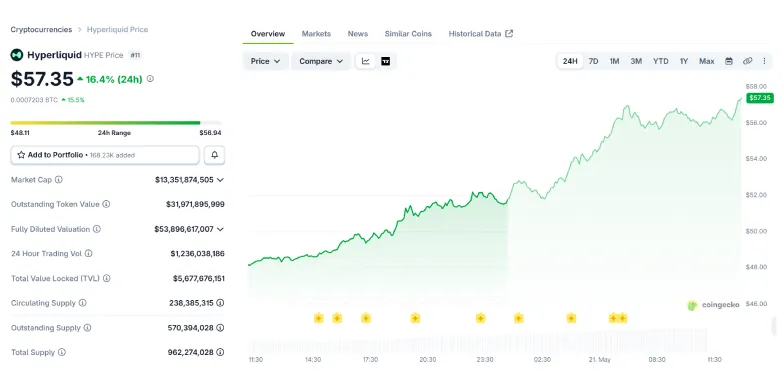
- Hyperliquid beat Solana at Fully Diluted Valuation (FDV) today, May 21, 2026.
- There has been strong demand for the newly launched US Spot HYPE ETFs.
- Institutions like Galaxy Digital and Grayscale Investment are raising funds worth HYPE.
Hyperliquid (HYPE) has surpassed Solana in fully diluted valuation (FDV), marking a major milestone for the token. Hyperliquid’s FDV is now about $54.57 billion, beating Solana’s FDV of about $54.21 billion. The token’s strength in the market is reflected in its price, which has jumped nearly 16% and is hovering around the $56 mark after surpassing $50.
This move where the token price crossed $50 is getting a lot of attention, be it from traders or institutional investors. The price is up and it also shows how much interest in Hyperliquid has accelerated since its debut in US ETFs.
The launch of ETFs and heavy trading explain the rise
The main reason behind Hyperliquid’s sudden rise is the launch and early performance of Hyperliquid ETFs in the US. The two organizations leading these funds are 21Shares’ THYP and Bitwise’s BHYP. Both products have shown rapid inflows and trading volume since their listing.
The data shows that 21Shares Hyperliquid ETF ($THYP) has seen its daily trading volume multiply nearly eight-fold since the product first came to market and is currently processing tens of millions of dollars in daily volume. This increase in liquidity came after the ETF listing and coincided with a strong rally in the HYPE underlying token.
ETF flows were significant in dollar terms. Combined net inflows into Hyperliquid’s first U.S. ETFs reached about $40 million in the first week of trading, according to a Bloomberg analyst. Eric Balchunas. Early demand of this size suggests that traditional finance participants are moving quickly to gain excessive liquid exposure through regulated ETF wrappers, which in turn increases buying pressure in the spot market versus HYPE.
The community compares these ETF flows to those that existed early on Bitcoin and Ethereum Spot ETFs. According to cryptocurrency analyzes shared by market commentators, the market cap of Hyperliquid ETFs, adjusted inflows during the first three trading days exceeded the inflows of Spot Bitcoin ETFs in five of the first six trading days.
Solana ETFs outperformed Hyperliquid ETFs on four of the six days, but on day six, Hyperliquid ETF inflows were significantly higher than their peers, according to SoSoValue. These comparisons show that Hyperliquid attracted unusually strong early demand compared to the size of the market.
One additional metric investors are monitoring: ETF purchases of $HYPE tokens appear to be greater than the amount removed from trading through the Hyperliquid Aid Fund buy-and-burn activity. In the early days after the ETFs were launched, the amount the ETFs took in was about 2.5 times the amount the fund bought and burned. This suggests that ETFs are a net source of buying pressure, adding to price momentum.
Institutional activity and whales increase buying pressure
Unlike ETFs, on-chain data and exchange movements show significant accumulation of tokens by large wallets and institutions. Multiple wallet addresses linked to well-known organizations were active in the past week.
Associated Galaxy Digital Activity, a wallet associated with Galaxy Digital (0xBED9) purchased 158,100 HYPE, roughly $8.8 million, in a short two-hour window. Such coordinated purchases from institutional trading desks can move markets and give a signal of confidence to other traders.
Furthermore, the newly created wallet (0x4CBB) has withdrawn 536,247 HYPE (about $29.87 million) from Coinbase During the past two days. Large withdrawals from exchanges usually indicate accumulation by private holders or institutions preparing to staking, cold storing, or holding tokens long-term rather than trading them.
Grayscale associated cadastral signature
Grayscale, a cryptocurrency investment manager that has previously filed for several spot cryptocurrency products, filed an S-1 filing for a potential HYPE ETF earlier this year. On-chain records show that two wallets linked to Grayscale purchased 510,387 HYPE (about $24.95 million) over the past week and then deposited those tokens. Grayscale’s active buying and storing adds another institutional layer to ordering and reduces circulating liquidity.
Why are these moves important for price and FDV?
When large investors, ETF funds, and crypto whales start buying at the same time, it usually causes a powerful chain reaction in the market. ETF providers typically need to purchase the physical token to support investor demand, while institutions and whales remove large amounts of supply from exchanges. This could push prices up quickly, according to us Excessive fluid projection.
At the same time, ETF listings bring more trading activity, liquidity, and public interest, making it easier for other investors to enter the market. As media coverage and on-chain data show increasing institutional interest, more retailers and momentum buyers are joining in, adding more buying pressure. Together, these factors can quickly increase a token’s market cap and fully diluted valuation (FDV).
In the case of HYPE, a sharp price rise pushed FDV higher than Solana, demonstrating how quickly institutional demand can reshape cryptocurrency market rankings.
At the time of publication, the price was The noise3.35%The token is at $57.35 with a 16.4% rise in the last 24 hours according to Queen Gekko.
Institutional demand is pushing higher, but volatility risks remain
Hyperliquid’s recent rally above the $50 level and short FDV volatility on Solana highlight how quickly institutional demand can change crypto market rankings. Strong ETF inflows, rising trading volumes, and large whale purchases fueled the move, while activity related to companies like Galaxy Digital and Grayscale Investments added to the bullish sentiment.
However, investors should monitor the risks. Heavy buying from ETFs and large institutions can lead to sharp price swings once momentum slows or traders start taking profits. Market concentration is another concern, since a few large funds that control most of the inflows could generate significant volatility if they rebalance or reduce exposure. Regulation also remains important, as future ETF approvals and investor demand depend a lot on the evolving US cryptocurrency policy environment.
Additionally, cryptocurrency markets are highly sentiment-driven, which means negative news about ETFs or institutional participation can quickly lead to a momentum reversal.
Several indicators may help know whether the rally can continue or not. Inflows from ETFs have been steady and growing; Daily trading volumes also indicate continued institutional interest. Exchange data is also important, as large drawdowns usually indicate future selling pressure. Cross-chain activity, such as staking or transfers to cold wallets, can show whether whales and institutions are planning to hold for the long term. Traders are also watching whether HYPE can stay above $50 and continue to outperform Solana in terms of FDV over the coming weeks.
Read also: Hyperliquid taps Coinbase for key liquidity role for USDC


