

Ethereum ($ETH) has found itself under intense selling pressure over the past few weeks. Despite numerous attempts by the bulls to push the asset back to higher trading levels, the market dynamics have shifted significantly in favor of the bears.
Will Ethereum Collapse Below $2,000?
According to the current technical structures on the chart and broader market indicators, there is a high risk that the Ethereum price will fall below $2,000. The asset is currently facing strong public resistance and a lack of spot buy walls. Market data confirms that whale distribution has accelerated, which has significantly affected spot market liquidity.
While short-term relief bounces are always possible in derivatives-based markets, the overall multi-week trend highlights a series of lower highs and lower lows. If the current support areas fail to cap the bears, a continuation towards the next major demand area below $2,000 looks very likely before the end of Q2.
Ethereum price analysis in May 2026
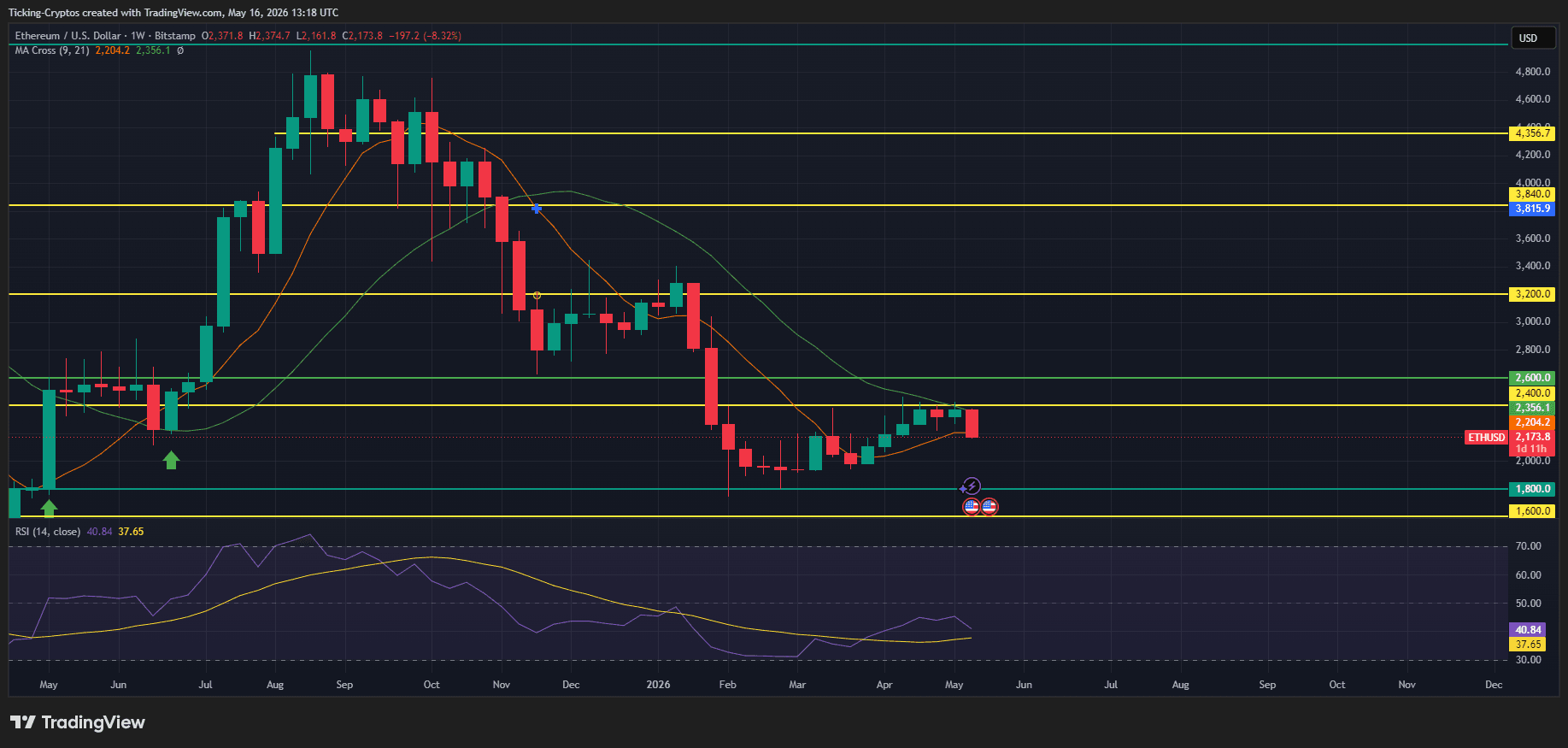
A detailed examination of the weekly chart of ETH/USD reveals a clear breakdown of the medium-term bullish structure.
Moving average crossover and bearish sentiment
- The chart shows a trace of the 9-period and 21-period Moving Averages (MA Cross) above the current price action. The 9-period moving average is at $2,204.3, while the 21-period moving average is hovering higher at $2,356.1.
- The fact that the current price is trading at $2,174.5 – well below both short-term moving averages – proves that immediate momentum is firmly in the hands of sellers. Sustained placement below these lines often turns former support areas into stable overhead supply walls.
Horizontal support and resistance levels
Several major horizontal areas are charted on this weekly time frame:
- Upper ceilings: Strong resistance lines have been established at $2,400, $2,600, and $3,200. These levels served as standardization floors before the main distribution phase began.
- Current battlefield: The immediate line of defense for buyers is around the green support range between $2,161 and $2,180. The current weekly candle is testing the bottom of this range, recording a net loss of over 8.29% for the current period.
- Floors under $2,000: If the $2,161 low collapses, the chart reveals a massive liquidity void. The next structured support ranges await lower at the $1,800 green line and the final overall support level of $1,600.
Overview of the Relative Strength Index (RSI).
At the bottom of the chart, the 14-period Relative Strength Index (RSI) is currently at 40.86, and the signal line is at 37.66. While an RSI reading near 40 shows that the asset is approaching oversold territory, it has not yet reached the traditional oversold threshold of 30. This means that there is still plenty of room for downside extension before the market forces a structural momentum-based reversal.
Why is Ethereum collapsing?
Accelerate whale distribution and exchange flows
Data from blockchain analytics platforms highlights a worrying trend regarding Ethereum Bulls. Over the past two weeks, ETH exchange reserves have risen significantly. Hundreds of thousands of Ethereum coins have been transferred to centralized trading venues, strongly indicating an intention to liquidate the asset.
This distribution is primarily driven by large-scale institutional wallets and “whales” holding between 10,000 and 100,000 ETH. When large entities transfer their properties to… Exchangesit floods the order books with supply that retail buyers struggle to absorb.
Decreased institutional flows
The institutional narrative that pushed Ethereum higher throughout the previous quarters has slowed. Net outflows from USD Ethereum ETFs further pressured the market, weakening overall spot demand. At the same time, major treasuries have reported lower hedging rewards and lower yield income due to compressed network valuations, prompting institutional players to adjust their portfolios to maximize capital flexibility rather than holding them for the long term.
What can save bulls?
To negate this extremely bearish scenario, Ethereum buyers need to immediately rally and force a daily close above the 9-period moving average at $2,204. Restoring this secondary level would indicate that domestic demand is active. However, completely negating the overall trend would require a strong push beyond the $2,335-$2,400 resistance range. Only a weekly close above $2,400 would reliably return the structural bias to neutral or bullish.
As overall asset trends go through these aggressive distribution phases, securing digital assets outside of centralized exchanges becomes highly recommended. The use of cold storage options, which can be explored in detail by comparing our hardware wallets, ensures that market fluctuations will not impact the safekeeping of assets.


