

- In Bitcoin 2026, Eric Trump stated that Bitcoin is currently in its “greatest period ever.”
- Market data shows a contradictory picture.
- This phase may reflect a structural shift and not the peak of the bull cycle.
Eric Trump, the founder of the American Bitcoin company, has been very vocal about his support for cryptocurrencies since 2025, especially with the Trump family’s expansion into cryptocurrency projects that included mining and tokenization projects. Recently, in Bitcoin 2026, Eric Trump introduced one of the strongest currencies Data yet. According to him, Bitcoin is currently going through its “greatest period ever.”
Trump said the past six months have been more transformative than the previous three years combined. To support his statements, he relied on the following points:
- Major banks have begun offering mortgage and custodial services backed by Bitcoin.
- There has been great success with spot Bitcoin ETFs.
- Institutions have shown great interest in the cryptocurrency industry and there has been increasing participation as well.
- There has been a growing tendency among coin holders not to sell, making Bitcoin more “sticky.”
“What Bitcoin has done in the last six months compared to the previous three years is transformative. “We are in the greatest period I have ever seen.”
-Eric Trump on Bitcoin 2026
In support of part of this view, Bloomberg ETF analyst Eric Balchunas noted that Bitcoin ETFs are among the most successful products launched in the history of ETFs, significantly expanding access for retail investors.
If one looks at the surface, this argument is indeed convincing. But when this argument is put against actual market data since late 2025, the picture becomes a bit more complex.
Bitcoin’s peak in 2025 and beyond
Bitcoin soared during the first few months of 2025. This rally was driven by ETF demand, institutional inflows, and overall optimism (Donald Trump’s announcement to make America the crypto capital of the planet), and with all of this the asset rose to an all-time high above $126,000 according to CoinMarketCap.
But then the crash happened on October 10, 2025 (also known as the 10/10 crash). Since this crash, the entire cryptocurrency market entered a correction phase that extended until 2026. Bitcoin has since been unable to recover its highs and has been consolidating and declining for a long period. At its weakest point, the asset was trading as low as $60,000, roughly 40-50% below its all-time high.
At the time of publication, the price was Bitcoin-0.41% The token stands at $76,423.96 with a decline of 0.17% in the past 24 hours according to CoinMarketCap.
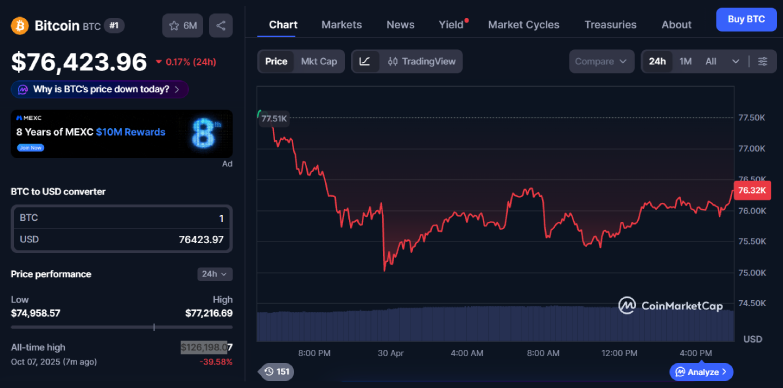
The main contradiction here is whether or not the current situation is still the greatest period ever for Bitcoin and the cryptocurrency market in general.
ETF inflows: strong start then sustained outflows
One pillar of Trump’s argument is institutional adoption through ETFs. Early data supported this account, at least initially.
According to data collected from SoSoValue, an AI-powered cryptocurrency, investment, and research platform, there have been significant outflows and inflows since the crypto collapse. An image of the same image is attached below:
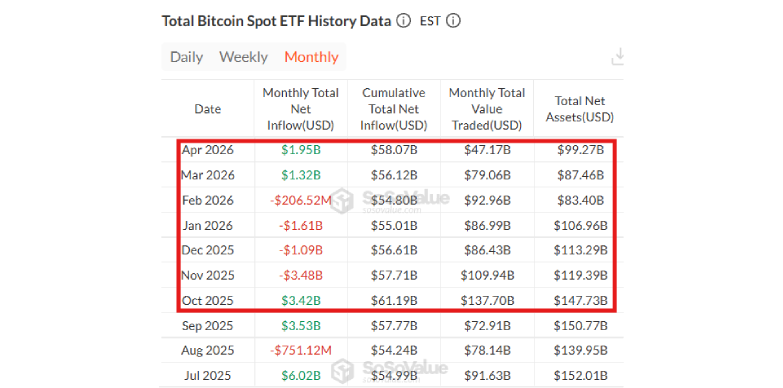
From the numbers, one can see that there is definitely a pattern. After strong inflows in October 2025, the market has seen four consecutive months of outflows, indicating hesitation by institutional players, profit-taking, or simply risk-averse behaviour. However, the last two months, March 2026 and April 2026, saw inflows and momentum started to recover.
This data contradicts what Eric Trump He has said regarding the best stage of Bitcoin. If BTC was truly at its strongest point, there would have been a steady buildup, not a sharp reversal followed by a partial recovery.
Transformation of emotions: from euphoria to fear
Market sentiment adds another layer to the analysis. During Bitcoin’s peak in October 2025,… Fear and Greed Index in Cryptocurrencies Reflects 71 which indicates that market sentiment was greedy. However, as prices fell, sentiment turned neutral and then entered fear territory in early 2026.
The decline in sentiment was not purely technical but was macroeconomic driven. Rising geopolitical tensions around the Strait of Hormuz have added a significant amount of pressure to global risk assets, including cryptocurrencies. The uncertainty surrounding energy markets and trade flows spilled over into investor behaviour, accelerating risk aversion.
At its lowest levels, around February 12, 2026, the Fear and Greed Index fell to a low of 5, an extreme reading even by cryptocurrency standards. To put things in perspective, this level of fear was lower than during major market shocks, which include the FTX crash in 2022 and the global market panic during the coronavirus (COVID-19) crash in 2020.
This is important because sentiment usually drives the price. The “Greatest Era” narrative typically aligns with sustained optimism, aggressive drip buying, and strong investor conviction. Instead, the market showed hesitation and fragility, as participants reacted cautiously to volatility rather than embracing it.
Bitcoin Dominance: Strength or Defensive Positioning?
Bitcoin dominance has remained relatively high since late 2025, with an annual high of 65.1% on June 27, 2025, and currently hovering around 59.9%, according to CoinMarketCap. While this represents a decline, the level is still high compared to typical altcoin-driven bull phases, where dominance tends to decline sharply.
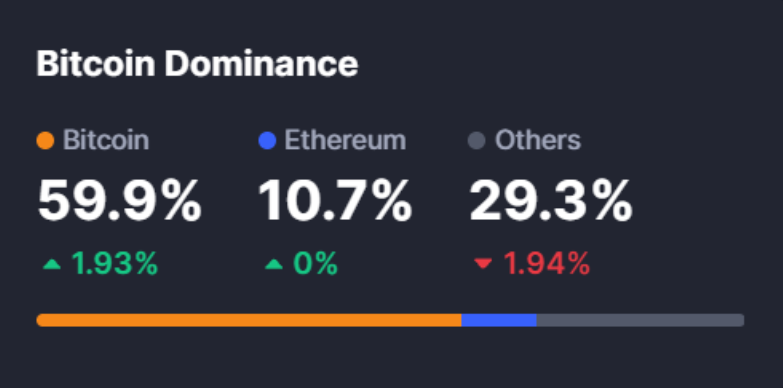
Rather than indicating a broad market expansion, this trend indicates cautious capitalist behavior, with investors preferring Bitcoin over riskier altcoins. In this sense, the current dominance levels reflect a defensive position within cryptocurrencies rather than a broad bullish rotation.
Is this really Bitcoin’s “greatest period”?
The answer depends entirely on perspective. If one focuses on structure, Eric Trump’s argument becomes much stronger. Institutional adoption is at an all-time high, Bitcoin-related financial products are expanding rapidly, and regulatory and political compliance is improving as well. Moreover, the ability to access markets has expanded significantly through ETFs and traditional financial channels.
However, if we look at the other side and focus on market data, the picture looks less convincing. Bitcoin remains well below its peak, ETF inflows have been inconsistent with several months of massive outflows, and overall sentiment has cooled from extreme greed to periods of fear.
Capital turnover trends also point to caution rather than aggressive expansion, as investors favor Bitcoin over altcoins rather than spreading risk across the broader market. From this standpoint, describing the current stage as “the greatest period ever” seems premature.
Final thought
The statement made by Eric Trump at Bitcoin 2026 embodies a powerful narrative in which Bitcoin is no longer a fringe asset, but is steadily integrating itself into mainstream finance. However, data since October 2025 tells a more cautious story.
The market has seen a sharp pullback from its highs, endured months of institutional flux, and witnessed a shift in sentiment from greed to fear. All of this suggests that although Bitcoin may be entering its most important structural phase, it is, at least for now, not the strongest conditions for market performance, and this distinction is important.
Read also: Bitcoin drops below $78K as BTC liquidations shake the cryptocurrency market


