

The developers recently revealed that a four-year-old vulnerability in Orchard may have enabled an unlimited number of Zcash (ZEC) counterfeits until an emergency patch was released. However, new market data has raised more questions about events prior to the discovery.
Allium Labs, after reviewing the trading history, has identified unusual trading activity. On May 26, ZEC’s trading volume rose 12-13 times above its average. Researchers secretly discovered the flaw three days later, on May 29.
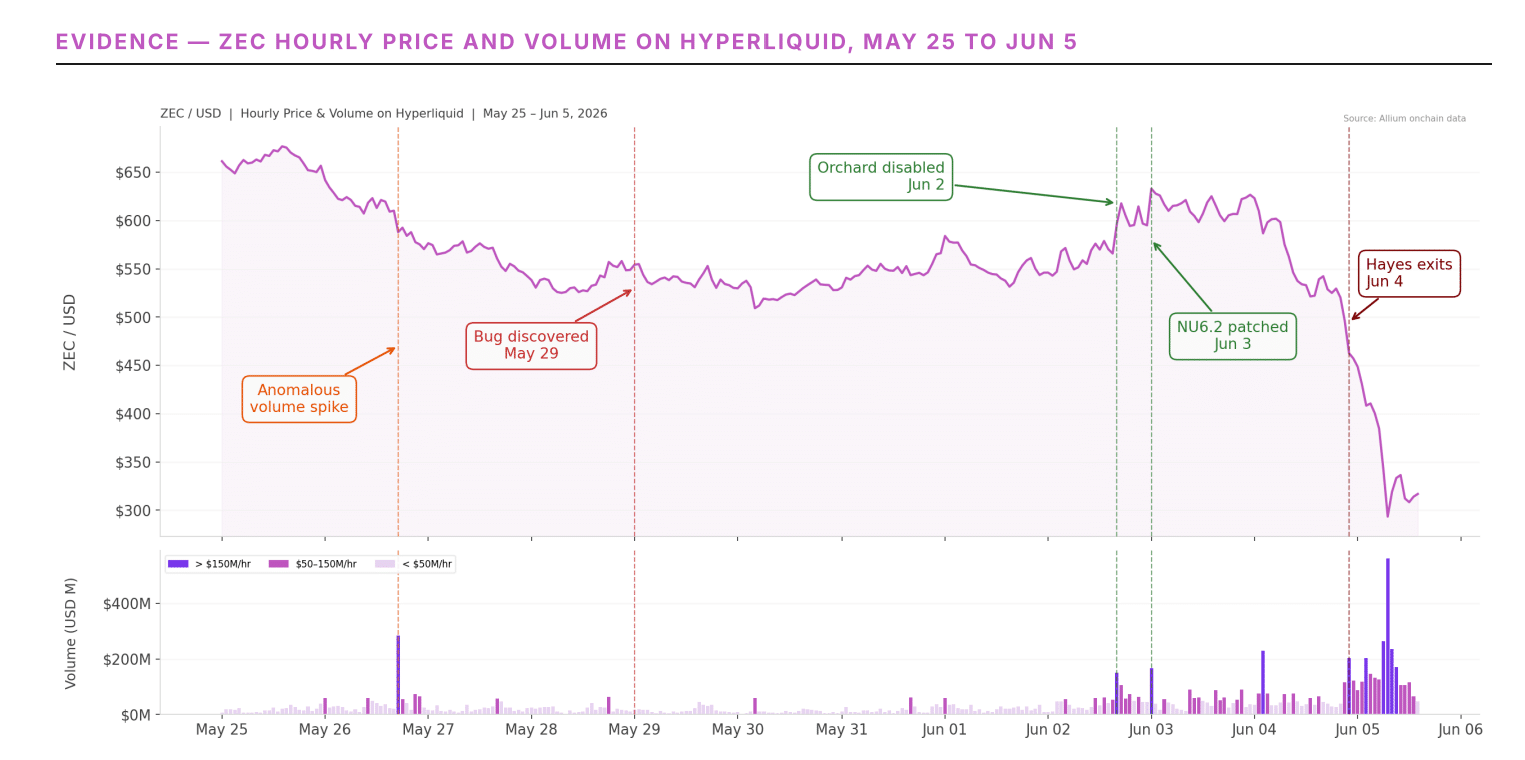
While researchers were identifying the flaw, ZEC fell from around $660 to $530, indicating increased selling pressure. Disable developers grove on June 2nd and issued a patch on June 3rd, yet confidence continued to wane.
By June 5, ZEC had fallen 64 percent from $685 to $247 with hourly trading at $560 million.
Early positioning fuels market uncertainty
The uncertainty in the wake of this issue has also led to further review of parties that were actively trading in the market before the issue arose. Allium found that traders opened the most profitable positions on May 25 and 26.
This happened days before the private discovery of the Orchard bug. Importantly, traders opened these large positions before researchers privately revealed the flaw on May 29. Notably, the largest portfolio had a short position of $34.5 million, resulting in profits of around $998,000.
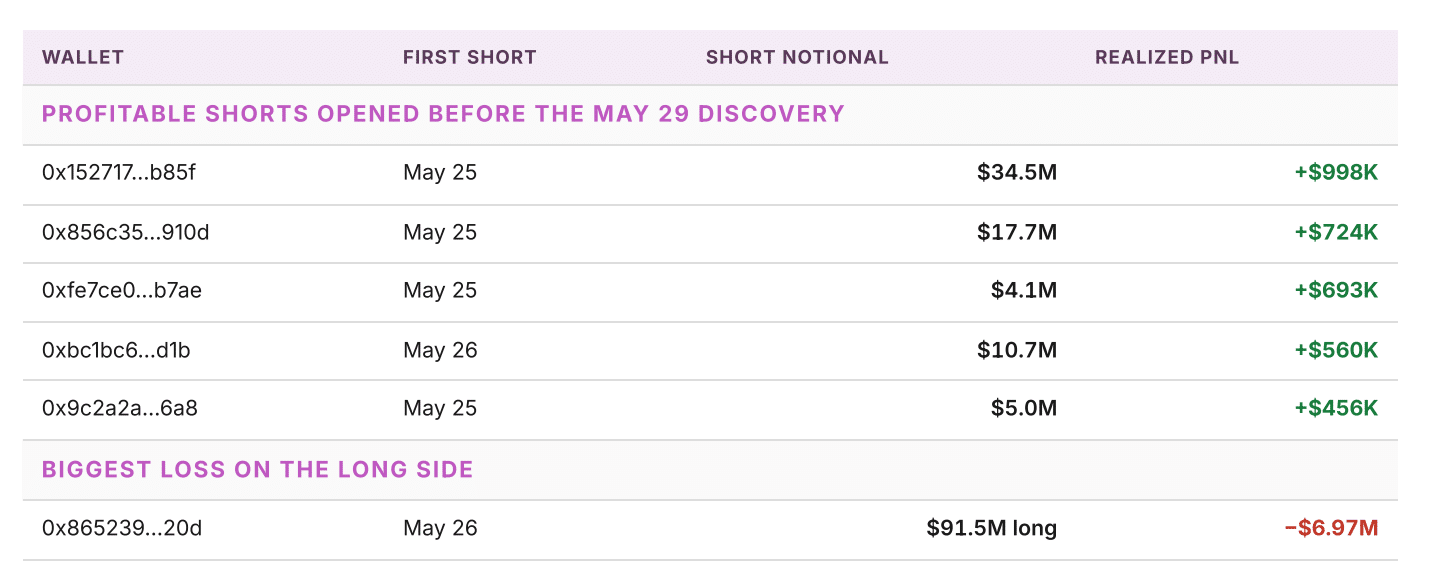
The second short position of $17.7 million netted profits of about $724,000. These higher profits raised questions about whether traders were anticipating a sell-off.
However, the data does not provide sufficient evidence to substantiate such claims. In futures markets, all sell trades are offset by an equal number of buy trades. Therefore, simply showing profitable positions is not enough to prove that those positions existed due to prior knowledge.
This balance became apparent when the largest long position of $91.5 million eventually lost $6.97 million. Meanwhile, Zcash’s privacy model prevents anyone from verifying whether the flaw has been exploited. This has left markets pricing on probabilities rather than certainty and has kept confidence fragile despite the completion of the correction.
Final summary
- Allium Labs reported unusual ZEC trading before the Orchard flaw was discovered, raising doubts about informed positioning.
- The lucrative short trades raised questions, but the lack of evidence and Zcash’s privacy kept trust fragile.


