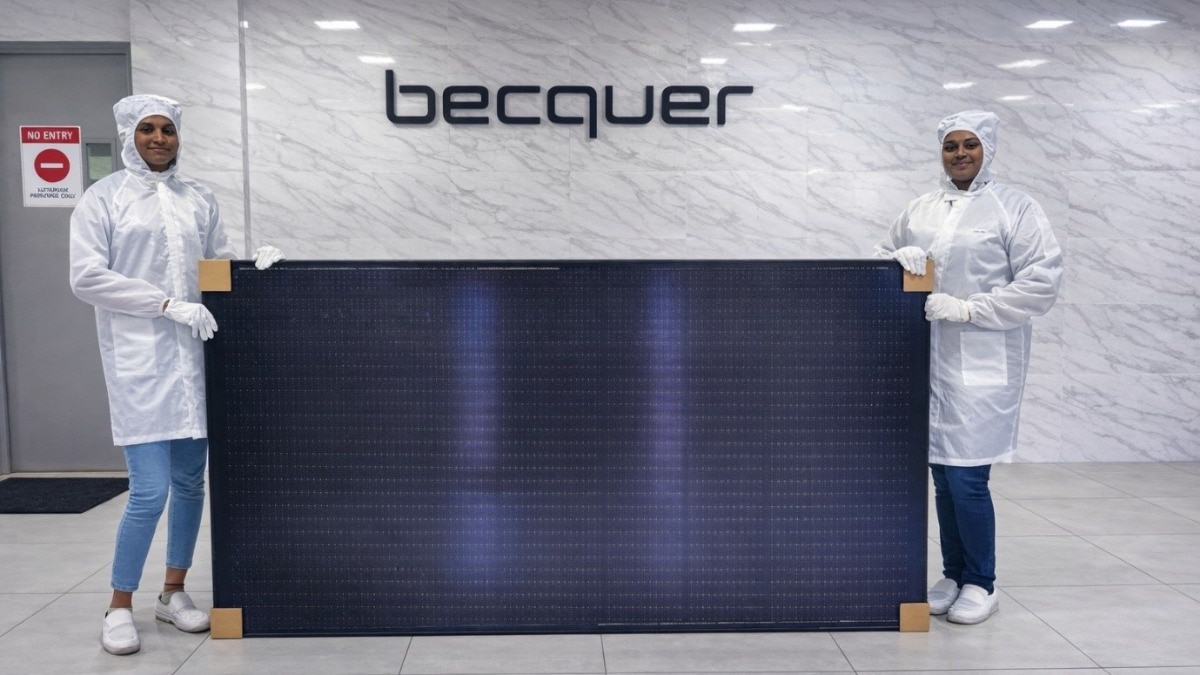
Becquer Energy, through its solar manufacturing arm Becsa, continues to redefine solar technology in India by launching more advanced, high-performance solar panels specifically designed for hot Indian conditions, building on the realities and challenges of grid-related operations, enabling on-site battery storage, in a market like India where all companies have traditionally reused the same cookie-cutter technology and assembled modules with the same features.
Becsa recently launched India’s first BIS certified HJT (Heterojunction Technology) solar module – BEC-HJT, which is a big leap over the conventional modules used by most OEMs. HJT modules provide up to 15% higher power output, 20% better heat tolerance, and reduced long-term degradation, translating into significant additional savings or revenue for megawatt-sized projects. With a 30-year warranty, these units are designed for long-term reliability in India’s tropical climate. This technology has already been deployed at Asia’s largest solar facade facility at D’décor’s Tarapore facility, and across plants in the automotive, steel and fast-moving consumer goods sectors.
As its founder and product curator, Mr. Sambhav, said, solar energy is not just an EPC product or a financial contract as most solar companies sell it, but a fundamentally new form of energy production, transmission and even end use, which requires rethinking materials, designs and manufacturing systems from their core. For example, it enabled battery compatibility in its solar devices installed a decade ago, allowing for easy plug-and-play today as a use case for storage gains.
Building on this technology leadership, Becsa also launched the SL Series, a solar module specifically designed for towers and residential homes. Unlike bulky replica designs common in the market, the SL Series has been researched and developed in India for over three years to address real challenges such as limited roof space, congested access points, safety and ease of handling. With moderate module sizes, high cell efficiencies ranging from 22.5% to 23.5%, thick frames, convenient treatment points, no risk of leakage, and the optional Fast Stop Safety (FSD) feature, the SL Series is one of the most reliable and aesthetically refined residential solar modules available today. The product has already helped Becsa achieve leadership in branded residential projects in Mumbai and Navi Mumbai, and is now set to expand into new cities.
Industrially, Becquer’s integrated solar devices have been deployed in large manufacturing facilities such as RR Kabel, providing one of the longest-running single-row solar installations with enhanced glass thickness, minimal downtime, and a comprehensive, industry-leading 30-year warranty. These systems are designed to provide higher efficiency at lower life cycle costs, resulting in savings of approximately 20 paise per watt compared to traditional solutions. Becker has also commissioned India’s largest industrial solar facade, demonstrating how solar energy can be seamlessly integrated into building structures to generate energy, improve aesthetics, and naturally reduce indoor temperatures and air conditioning costs.
With manufacturing capabilities that allow solar cells to be integrated with virtually any building material, Becquer and Becsa are expanding the role of solar energy beyond rooftops – to future-ready facades, structures and infrastructure. As India accelerates its transition to clean energy, Becker is pioneering the most advanced panels, smartest designs and tailored solutions for Indian industries and homes.
Commenting on his partnership with Becsa, Mr. Hitesh Vageha believes in “Akalmand Bano, Sahi Chuno” and extending this ideology, Becsa and RR Kabel have joined hands to promote high efficiency solar modules along with premium quality solar cables that have material superiority in their insulation. While the Becsa modules will provide a higher power output, the RR Kabel DC cables will ensure a high enough transfer of that power through the cables.
While some solar module OEMs are rebranding imported cables to increase revenue opportunities, at the same time there are no technological advantages and they do not withstand the heat of tough environments like those in India. For extreme thermal cycling, high UV exposure, or submerged/floating installations, RR Kabel’s dedicated polymer R&D and e-beam processing provide a longer and more flexible life cycle (>25 years), compared to the standard cross-linked chemical polymers used by standard cable providers.