

Russia is moving forward in its quest to bring digital assets into international trade, but not as quickly as initially planned. After passing its first reading in April, the government’s cryptocurrency bill was reviewed and passed for the next stage. Russia’s State Duma committee approved a revised draft law on cryptocurrency regulation for its second reading, removing proposed requirements for declaring cryptocurrency wallet addresses while adding provisions for investments funded in cryptocurrencies and New transfer controls.
The main advantage for businesses has not changed: cryptocurrencies remain banned for domestic payments but allowed for cross-border trade. Meanwhile, Bitcoin is shining with strength of its own, closing above key long-term support for the third week in a row. Below we cover both the regulatory update and what the BTC chart indicates.
Where does Russia’s cryptocurrency bill stand now?
He has passed one of the three required readings. The bill, officially titled “On Digital Currency and Digital Rights,” passed its first reading with 327 out of 340 deputies voting in favour. It has since been reformulated. Russia’s Financial Markets Committee approved the revised draft law for its second reading, with Chairman Anatoly Aksakov saying the proposal removes wallet address reporting while strengthening legal protections for cryptocurrency holders.
More importantly, voting in the second reading hall has not yet taken place. The committee’s approval was announced through Aksakov’s Telegram channel, and records on the Duma’s website have not yet been updated since the bill was first read in April. It still needs two readings in the Duma, approval by the Federation Council, and a presidential signature before it becomes law.
What changed in the amended draft law?
Several things. The updated draft no longer requires cryptocurrency holders to declare wallet addresses; Instead, users will only need to report wallet balances and transaction volume. Aksakov said the review aims to reduce the risk of sensitive information being disclosed in ways that could be used against Russia.
New provisions for investment and supervision have also been added. It will allow investors to buy Russian securities and digital financial assets using cryptocurrencies, and licensed Russian brokers and asset managers will eventually have access to approved forex. Crypto exchangessubject to additional terms. Retail investment limits remain unchanged, while the bill introduces a new provision allowing authorities to delay some large outgoing cryptocurrency transfers for up to two days. The maximum retail value is 300,000 rubles per year.
Why is the cross-border trade angle important?
Because it gives Russian companies a settlement route outside sanctioned banking channels. The bill maintains the ban on cryptocurrencies for domestic payments while providing for their use in foreign trade, and in the revised text, covers investor eligibility, consumer protection, cross-border cryptocurrency transactions, and the use of digital assets in Russian financial markets. The scale is significant: Russian exporters and importers who move goods across an estimated $240 billion trade volume and face payment friction would have a legal path to settling contracts in cryptocurrency.
Only major assets are expected to be eligible. Only cryptocurrencies with a market capitalization of more than 5 trillion rubles (about $66.6 billion) and a trading history of five years will be eligible, with Bitcoin and Ethereum First approvals expected
When will the law go into effect?
Later than the original target. Finance Ministry official Alexei Yakovlev told Interfax that the draft law was largely ready but was unlikely to be adopted by the initial date of July 1, 2026, after it was sent back for committee review before its second reading. A firm replacement date has not been confirmed, so the timeline now depends on how quickly the remaining readings and approvals follow up.
Bitcoin Price Analysis: Why is the price of Bitcoin rising?
Bitcoin achieved its highest weekly close in five weeks. Notably, Bitcoin closed above its 200-week moving average support for the third week in a row — a resilience that stands out given the Nasdaq 100 index fell more than 4% over the same period. This divergence from technology stocks at a key support area is exactly what bulls want to see.
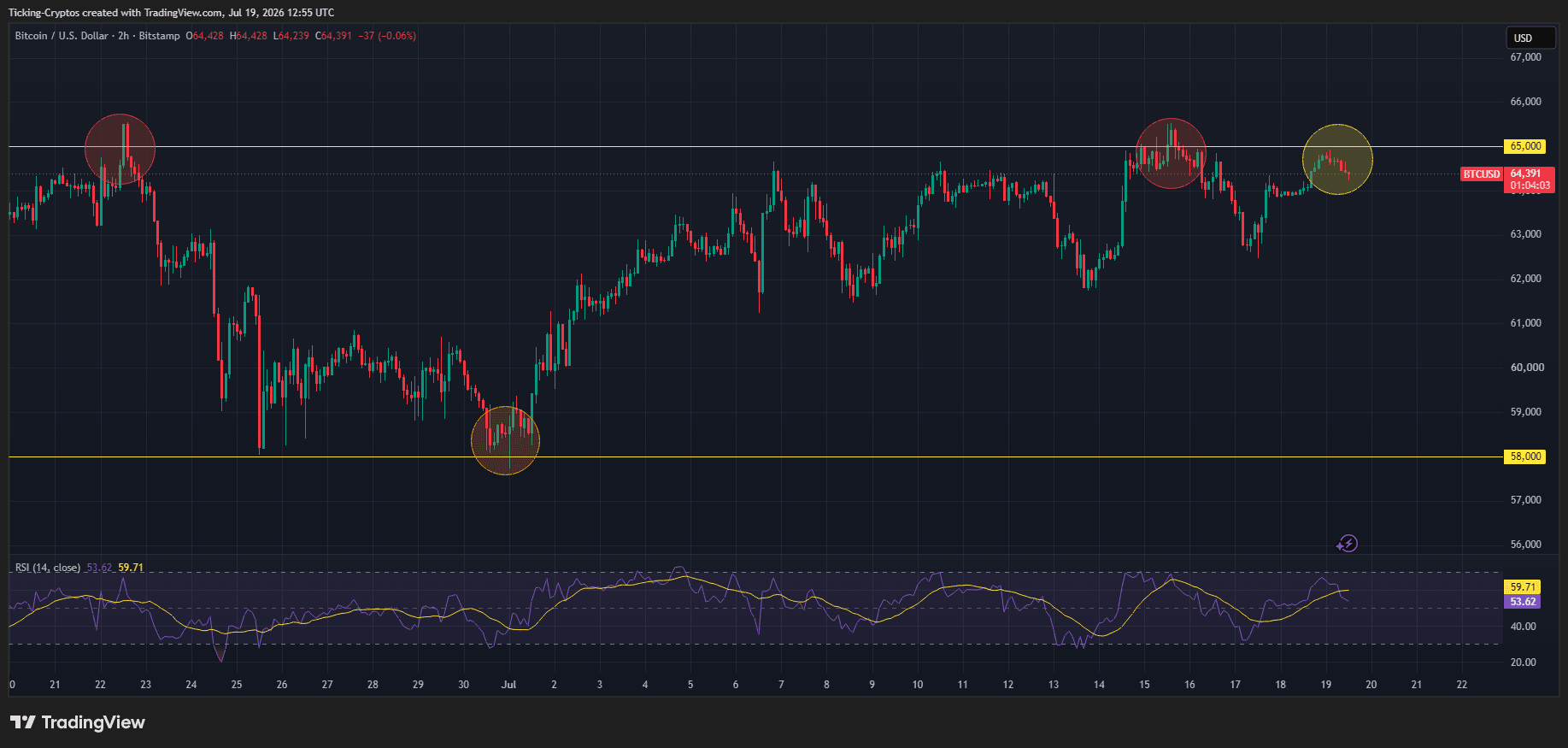
The artistic image is constructive. The MACD has turned to the upside, the RSI bullish divergence is still valid, and the RSI Stochastic is showing positive momentum. The bullish candle that appeared three weeks ago is also still holding – a pattern that has appeared three times this cycle, each time followed by a strong rally.
What are the most important Bitcoin levels?
The map is clean on both sides. Resistance is at $67,000, then $83,000. Support reaches $58,000, then $49,000.
There are two scenarios that stand out. If BTC holds above $58k, it could head towards $67k and then $83k. If BTC closes below $58k on the weekly chart, the next important support is around $49k. With the price currently trading near $64k, the weekly close of $58k is the limit to watch.


