


author
Ahmed Barakat
author

Share

The Bitcoin Network Activity Index crossed above its 365-day moving average for the first time since December 2024, entering… CryptoQuant Research News is officially classified as a bullish phaseThis is the same threshold that preceded the significant rise in prices in 2024 and 2025.
Daily Bitcoin transactions exceeded 800,000 in 2026, more than doubling from the lows in 2025, and the network activity index jumped from around 3,320 to around 3,600. The price of BTC at the time of writing is $62,500, down 2.5% over 24 hours.
Timing carries a lot of weight. The partial cooling off of the Iran peace deal removed some of the geopolitical risk premium that had been suppressing risk appetite across crypto markets, with BTC holding just above its 200-week SMA near $62,000, a level that has served as historical support for the longer session.
The combination of the up-stage network signal and the overall tailwind makes the downstream question a legitimate one. However, what the data actually shows is more complex than the headline suggests.
If we take away the price action, there is something structurally notable going on underneath. Whether it is signal or noise is the whole question.
Discover: The best advance token sales
Bitcoin News: On-chain activity, what a break of the 365-day moving average actually tells us
CryptoQuant’s Network Activity Index measures a composite combination of the number of transactions, active addresses, and block usage.
A break above its 365-day average has historically marked a transition to sustained bullish phase behavior, and it occurred in late 2024 and again briefly in April 2025, both of which preceded bullish price moves. The indicator is now in this range again for the first time in over a year, with average transactions per block approaching record levels for several weeks in a row, which CryptoQuant describes as structural rather than transitory.
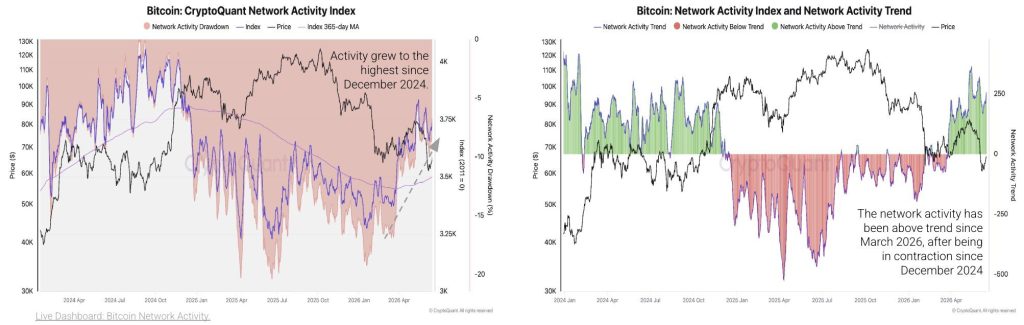
The accumulated data enhances the signal. Long-term holders of the coins, so-called HODL pools, hold more than 4.37 million BTC, up from about 2 million BTC in early 2024.
This represents a meaningful lock-up of illiquid supplies, which historically tightens available float before prices recover. VanEck’s analysis shows that approximately 43% of supplies have been idle for more than three years, in the historically high percentages.
The caveat is straightforward: “The economic content of these transactions differs materially from previous periods of high activity,” CryptoQuant said. Transactions of less than 0.01 BTC, about $630 at current prices, represent about 80% of total daily activity on the chain, up from 44% in 2023.
The rally in sub-0.001 BTC and sub-0.01 BTC blocks toward their previous highs in 2024 is driven almost entirely by OP_RETURN-based protocols: RONES, ORDINAL, BRC-20 tokens, and data timestamp services.
CryptoQuant noted that OP_RETURN usage “rose to near-record levels in 2026,” with these protocols generating large amounts of dusty-value microtransactions that “directly explains the increase in low-value pool.” The value transferred per transaction is, as the company plainly puts it, “negligible.”
The memory pool expanded to nearly 128,000 pending transactions, its highest level since late February 2025, with congestion concentrated in the low-fee tier. Cryptoquant warns that the continued expansion of protocol-based activity “could lead to increased fees on time-sensitive economic transactions,” which would ultimately impose real costs on real economic productivity. This dynamic is worth monitoring, but it has not yet reached the threshold that significantly disrupts settlement flows.
Discover: The best advance token sales


