

From escalating military conflicts to systemic fractures in banking and bond markets, the traditional financial structure is under enormous pressure. Under normal historical circumstances, such a barrage of negative catalysts would lead to severe and prolonged capitulation across the risk asset spectrum.
However, Bitcoin has not only been able to withstand these systemic shocks, but has managed to post consecutive positive monthly closes. This divergence between deteriorating global fundamentals and cryptocurrency market performance highlights a tectonic shift in investor psychology and asset allocation.
Has Bitcoin formed a structural bottom?
One of the basic principles in financial market analysis states that a market reaches its cyclical bottom when prices stop reacting negatively to bad news. Over the past three months, the macroeconomic environment has presented a relentless stream of worst-case scenarios. Despite this, Bitcoin price managed to print green monthly candles for both March (+1.81%) and April (+11.87%), with May continuing to hold positive territory (+0.65%).
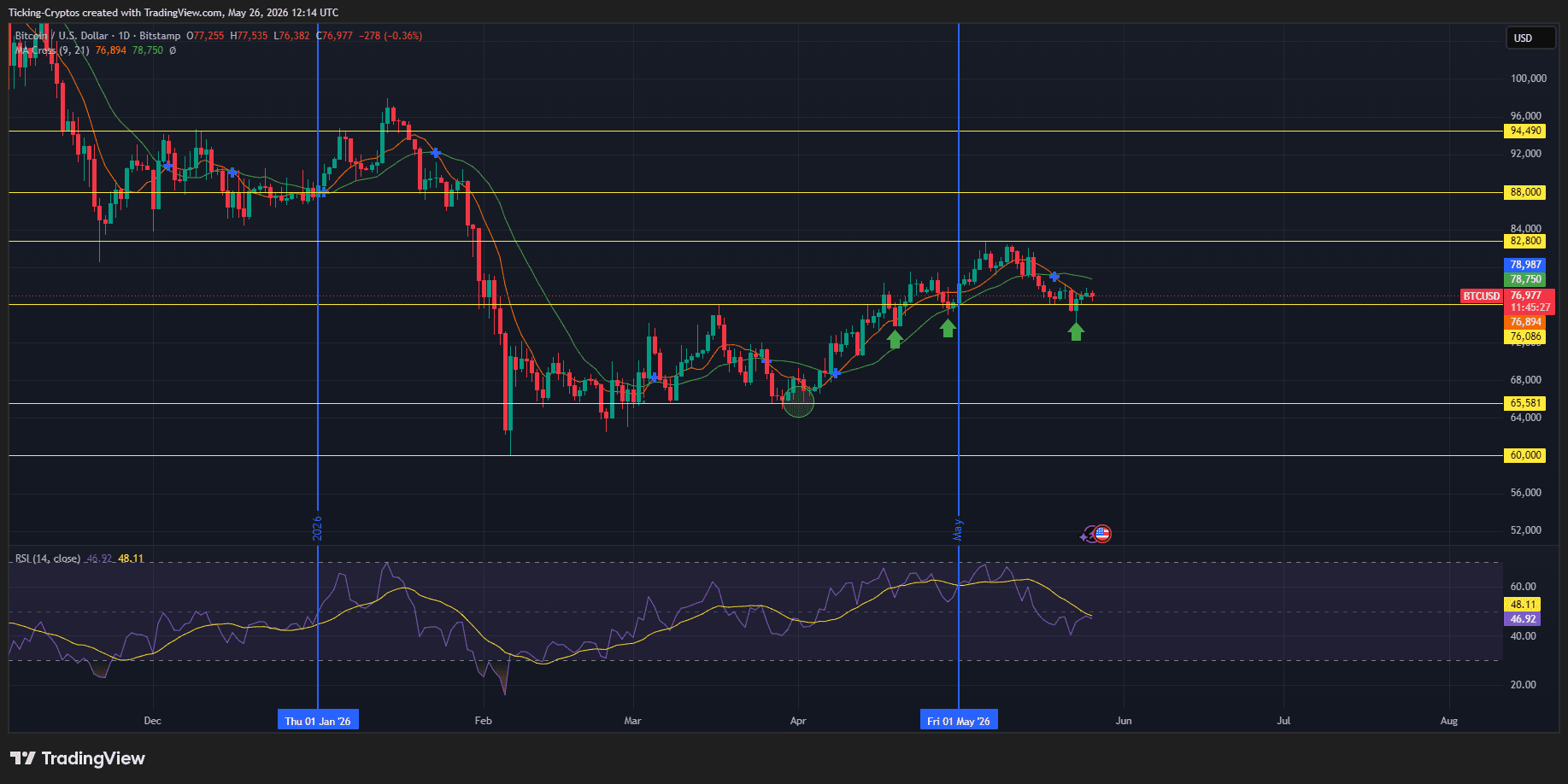
This continued strength in the face of macro headwinds confirms that selling exhaustion has been reached. The market has fully factored in the negative externalities, suggesting that Bitcoin’s cyclical bottom is well established.
The Macroeconomic Challenge: Three Months of Global Chaos
To appreciate the significance of Bitcoin’s current price action, it is necessary to examine the sheer volume of negative catalysts that have failed to bring the market down.
1. Geopolitical war (US and Iran)
The geopolitical landscape was severely fractured after the start of direct military clashes between the United States, Israel and Iran under these circumstances. Operation Epic Rage. The ensuing conflict severely disrupted the Strait of Hormuz – one of the world’s most important oil lanes – immediately threatening global trade and energy security. Historically, the sudden outbreak of wars results in an immediate flight from risky assets into cash and gold. While traditional stocks faltered, Bitcoin maintained its structural integrity.
2. High inflation rates and energy crises for several years
Due to the disruption of energy supplies due to the war, the headline inflation rate in all OECD countries rose strongly, reaching a multi-year high of 4.0% in March. In the United States, energy inflation rose by double digits, forcing central banks to reconsider their higher interest rate frameworks for a longer period. High inflation typically reduces consumers’ purchasing power and reduces liquidity – yet Bitcoin inflows have remained net positive.
3. Global stock dumps and bond market crisis
Meanwhile, public stocks suffered intense liquidations. The intersection of distress in highly leveraged private assets and rising long-term sovereign bond yields has sparked sharp volatility. Institutional investors have faced margin pressures globally, often forcing them to liquidate liquid assets to cover structural losses in the fixed income and real estate sectors.
4. Yen interventions and solution to carry trade
Currency markets saw severe turmoil as the Bank of Japan spent nearly 10 trillion yen in aggressive foreign exchange interventions to stabilize the rapidly depreciating yen. The steepening of the Japanese yield curve shook the foundations of the global macro “carry trade,” creating massive systemic instability in international finance markets.
5. Amount of FUD
Compounding these macroeconomic pressures, the cryptocurrency narrative has been hit by a wave of fear, uncertainty, and doubt (FUD) regarding the rapid progress in quantum computing. Exciting reports claimed that emerging quantum capabilities would imminently compromise Bitcoin’s SHA-256 encryption protocol, threatening the integrity of the network.
Why hasn’t Bitcoin collapsed yet?
Structural behavior observed in the encoder news The cycle reflects a classic financial phenomenon: Absorbing the climax of surrender.
Market assets achieve a macro trend reversal when the volume of structural sellers is completely exhausted. At this point, even the most severe macroeconomic cuts fail to produce technical lows because all participants inclined to panic selling have already exited the market.
Rather than serving as speculative technology stocks, Bitcoin is increasingly treated as a systemic hedge against fiat depreciation, sovereign debt crises, and geopolitical isolation. When the stability of major fiat currencies (such as the yen or euro) becomes questionable, or when banking systems face contagion, Bitcoin’s stable, politically neutral structure turns it into an alternative safe haven.
Data Analysis: Evaluation of monthly returns
An examination of the beta monthly returns highlights the anomalous nature of the 2026 price action:
| year | January | February | He walks | April | maybe |
|---|---|---|---|---|---|
| 2026 | -10.17% | -14.94% | +1.81% | +11.87% | +0.65% |
| 2025 | +9.29% | -17.39% | -2.30% | +14.08% | +10.99% |
| 2024 | +0.62% | +43.55% | +16.81% | -14.76% | +11.07% |
The sharp corrections observed in January (-10.17%) and February (-14.94%) erased late-cycle leverage and speculative retail positions. When geopolitical and inflationary shocks emerged in March, the market lacked the speculative sellers needed to push prices down. The subsequent recovery of 11.87% in April, under peak wartime conditions, was conclusive evidence of institutional accumulation.
Investors seeking to safely navigate these volatile market environments are increasingly shifting capital away from centralized platforms vulnerable to liquidity freezes, choosing instead to evaluate security frameworks using dedicated tools. Hardware wallets Comparative evidence for securing its sovereign assets.


