
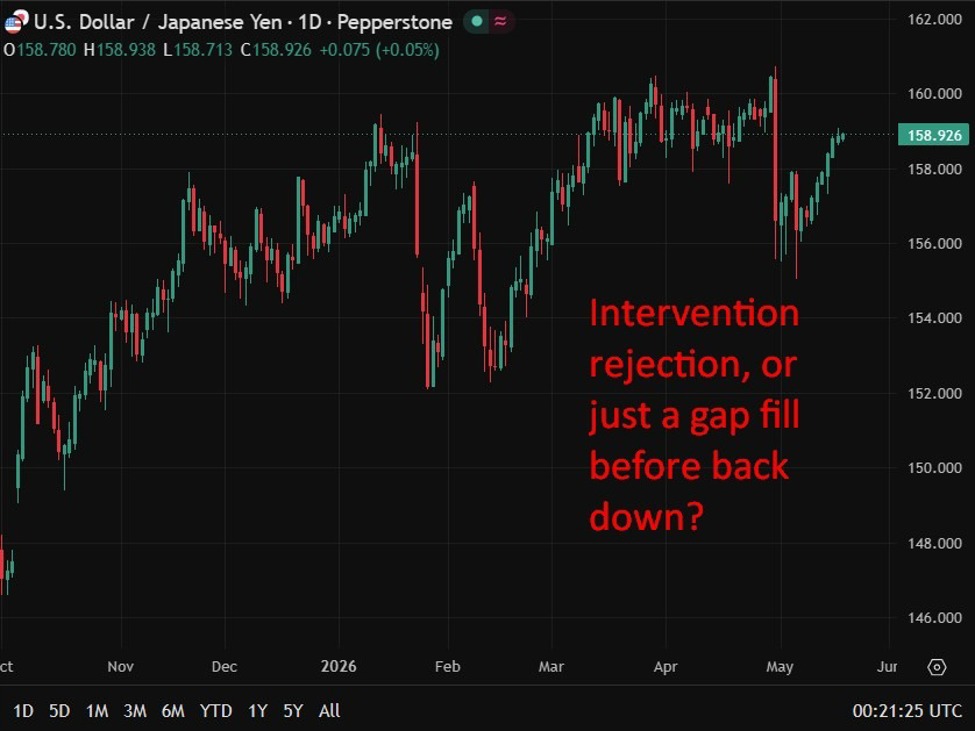
Despite suspicion Japanese intervention in the currency market totals about $65 billionThe USD/JPY pair is rising steadily.
–
The mechanism of intervention in the Japanese currency is located at the intersection of financial and monetary authority in a way that differs from most other advanced economies. The authority to intervene in foreign exchange markets rests not with the Bank of Japan but with the Ministry of Finance, a distinction that is often misunderstood but is fundamental to how the system works.
Under the Japanese Foreign Exchange and Foreign Trade Act, the Minister of Finance has the legal authority to conduct currency market interventions. When the ministry determines that the yen’s movements have become disorderly, excessive, or inconsistent with economic fundamentals, it instructs the Bank of Japan to execute trades on its behalf. The Bank of Japan acts as an agent in this process, executing physical transactions but exercising no independent judgment about whether or when to act. The decision is entirely political and administrative, not monetary.
The mechanics work through the Special Account of the Foreign Exchange Fund, a government account held at the Bank of Japan. When the ministry wants to buy the yen and sell the dollar, for example, it withdraws from the dollar reserves in that account. The Bank of Japan then enters the market and executes trades as directed. Japan has the world’s largest foreign exchange reserves, giving the ministry significant firepower when it chooses to deploy them.
In practice, intervention decisions involve close coordination between the Ministry’s International Office, the Foreign Exchange Division of the Bank of Japan, and often the Minister of Finance directly. Major operations are usually preceded by a period of increasingly pointed verbal warnings, a practice markets call “jawponing,” a practice designed to signal intentions and sometimes achieve a desired exchange rate movement without expending reserves at all.
Japan has intervened more explicitly in recent years to support the yen when it has weakened sharply against the dollar, most notably in 2022 (and now) when the currency has fallen to multi-decade lows. The ministry authorized the purchase of yen worth tens of billions of dollars through several operations. Results were mixed in the medium term, as the underlying interest rate differential that weakened the yen remained unchanged, but interventions succeeded in slowing and temporarily reversing the pace of the currency’s depreciation.
This arrangement reflects a deliberate constitutional choice to keep exchange rate policy out of the hands of the central bank and under the control of the elected government, a design that gives Tokyo a great deal of flexibility but also means that currency and monetary policy can sometimes be pulled in different directions.


