
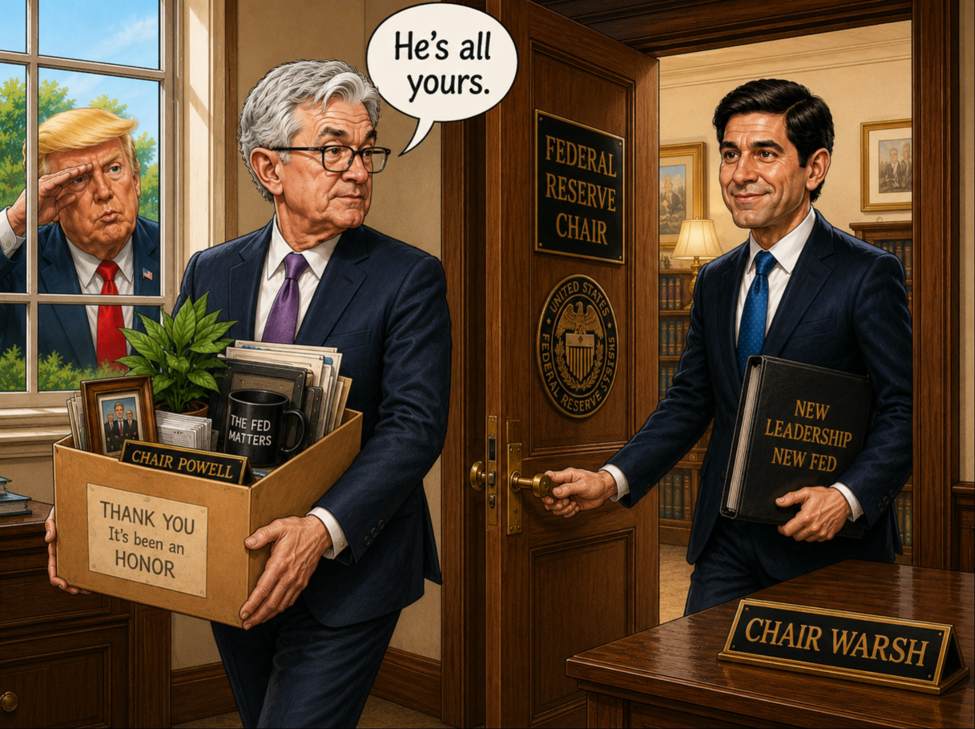
Powell exits amid another bond market rally
Jerome Powell is leaving the Federal Reserve chairmanship at a time when the bond market is under pressure again. The 10-year Treasury yield is posting its biggest weekly rise since April 2025, rising 23.5 basis points, or 5.39%, in just one week. After ending 2025 near 4.16%, the yield fell to a low of 3.926% before rising to a high of 4.599% today. The move highlights just how volatile the interest rate landscape has become – fittingly the end of one of the Fed’s most turbulent mandates in recent history.
A 10-year return roller coaster during Powell’s tenure
When Powell officially took over from Janet Yellen on February 5, 2018, the 10-year US Treasury yield was trading near 2.85%. During his tenure, the Treasury market experienced historic volatility. The low point came during the Covid scare of 2020, when the 10-year yield collapsed to nearly 0.50%, with some intraday trading briefly dipping below 0.40% as investors rushed into safe-haven assets. From there, yields saw a significant reversal, eventually peaking near 5.02% in October 2023 – the highest level since 2007.
That means Powell’s tenure saw the 10-year yield move across a range of more than 450 basis points from the pandemic lows to the 2023 highs — one of the most volatile interest rate cycles in the recent history of the Treasury market.
Rising inflation became the decisive macro story
The broader US economy has seen equally historic fluctuations under Powell’s watch. Inflation, measured by the consumer price index on an annual basis, fell to 0.1% in May 2020 during the coronavirus lockdown recession before rising to 9.1% in June 2022 — the highest inflation reading since 1981. This inflation shock eventually became the defining macroeconomic event of Powell’s presidency and forced the Fed into its most aggressive tightening campaign since the early 1980s.
GDP has seen a historic collapse and recovery
GDP growth has also been driven by unprecedented extremes. Real GDP contracted at an annual pace of -31.4% in Q2 2020 during the pandemic collapse, but rebounded by +33.8% in Q3 2020 as the economy reopened. Those successive quarters marked the largest contraction and rebound in modern American economic history.
The labor market has witnessed historical fluctuations
The labor market followed a similarly dramatic path. When Powell took office, the unemployment rate was close to 4.1%. During the coronavirus lockdowns, unemployment rates rose to 14.8% in April 2020 — the highest level since the Great Depression era. However, the recovery proved just as historic, with unemployment eventually falling to 3.4% in early 2023, the lowest level since 1969. Today, the unemployment rate is close to 4.3%, remarkably close to the level it was when Powell first took office.
Major political cycles under Powell
Looking back, Powell’s tenure can be largely divided into several major policy and market cycles:
- Tightening cycle 2018: Powell took office to continue the Fed’s gradual drive to raise interest rates inherited from the Yellen era.
- Pre-coronavirus 2019 relief: Slowing global growth and trade war fears led to the Fed shifting toward lower interest rates before the pandemic began.
- Covid 2020 crisis: The Federal Reserve cut interest rates to near zero, launched massive quantitative easing programs, and stabilized financial markets during the pandemic panic.
- Inflation shock 2021-2022: The Fed has downplayed its estimate of post-pandemic inflation persistence, delaying monetary policy tightening as inflationary pressures accelerate.
- Rapid tightening cycle 2022-2023: Powell then led one of the fastest interest rate hikes in the Fed’s history to regain control of inflation expectations.
- 2024-2026 TOP TALLER SHIFT: As inflation gradually eased, the Fed shifted toward maintaining restrictive policy before eventually beginning the process toward lower interest rates.
Powell’s legacy will continue to be hotly debated
Critics will likely point to the delayed response to post-Covid-19 inflation as Powell’s biggest policy mistake. The Fed initially viewed inflation as “temporary,” then had to engage in an aggressive tightening cycle once price pressures became embedded in the economy. However, supporters will say Powell has weathered multiple once-in-a-generation crises, including the pandemic collapse, banking sector strains, supply chain disruptions, and the biggest rise in inflation in four decades.
Either way, Powell’s tenure coincided with one of the most volatile and consequential macroeconomic periods ever administered by a modern Fed chair.


