

Key takeaways
- Cardano (ADA) faces losses below $0.2800 after Sunday’s 4% rebound was capped by the 100-day moving average.
- Negative funding rates and a shift in futures market sentiment indicate a bearish outlook.
Cardano futures market turns bearish as sentiment changes
ADA is down 2% in the past 24 hours and could record further losses in the near term. Cardano futures market sentiment turns bearish amid spot price decline this week.
according to Coinglass dataOpen interest (OI) for ADA futures rose more than 4% in 24 hours, to $596.40 million, indicating positions are accumulating as traders prepare for a potentially sharp move.
However, a negative funding rate of -0.0018% indicates that fewer traders are willing to take long positions on ADA, indicating a bearish outlook.
In addition, the buy-to-sell ratio stands at 0.7212, which indicates that the number of active short positions significantly outnumbers the number of long positions, reinforcing the downtrend.
Technical Outlook: ADA is facing resistance at the 100-day moving average
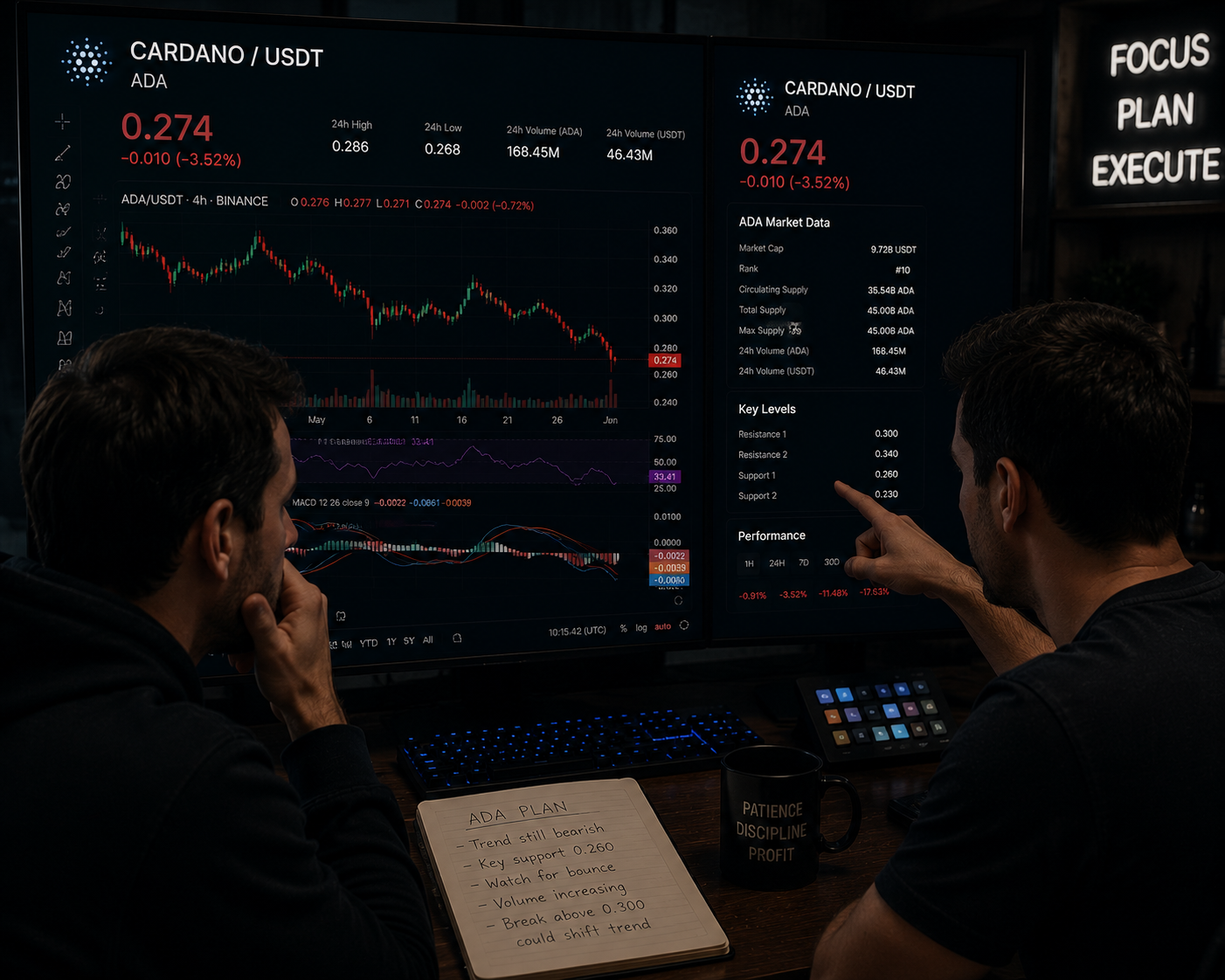
The 4-hour ADA/USD chart remains bearish and active. At the time of writing, Cardano is trading around $0.2743, maintaining a set tone below the 100-day moving average at $0.2870.
While ADA holds above the 50-day moving average at $0.2603, the technical structure remains cautious, suggesting that the broader downtrend could continue if support fails to hold.
The Moving Average Convergence Convergence (MACD) indicator is approaching the signal line, with positive chart bars contracting. Meanwhile, the Relative Strength Index (RSI) fell to 59, indicating that bullish momentum is weakening after an overly extended move.
If the rally resumes, immediate resistance will appear at the 100-day EMA near $0.2870, with the longer-term 200-day EMA around $0.3696 as the next important barrier.

However, if the downtrend continues, the 50-day EMA at $0.2603 offers the first noticeable layer of support.
Closing the daily candle below this level may indicate that the recent recovery is fading and that the broader bearish bias is reasserting itself.


