
The global dairy sector is likely to face “long-term impacts” from the ongoing conflict in the Middle East according to new analysis.
The escalation of the conflict, involving the United States, Iran and Israel, is severely impacting trade routes, energy prices and supply chains.
The increase in fuel and fertilizer prices around the world and its impact on farm and farmer margins has been well documented at this point.
But according to the UK Agricultural and Horticultural Development Board (AHDB), another significant problem facing the global dairy sector is “overproduction of dairy products”.
The global growth in milk production in 2025, which continued until 2026 and was also evident in Ireland, presents another challenge when it comes to supply and demand.
“Markets may come under further pressure with weak demand and an inability to absorb excess stocks,” AHDB explained.
Its latest analysis shows that milk deliveries in… European Union Consumption alone averaged 399.7 million liters per day in February, an increase of 20.6 million liters per day – compared to the same month last year, the strongest February on record.
The big question is if current production levels continue, how will this in turn affect prices?
Dairy products are a staple of Middle Eastern diets, and while Iran is largely self-sufficient, other countries such as the United Arab Emirates, Kuwait, Oman and Bahrain rely heavily on dairy imports.
According to OECD-FAO trade data, the Middle East accounts for about 15-18% of global dairy imports.
The size of the Middle East dairy market in 2025 is estimated at $19.5 billion, with imports mainly consisting of milk powders and functional dairy ingredients, AHDB said.
The top three imports included powdered milk, butter, and cheese.
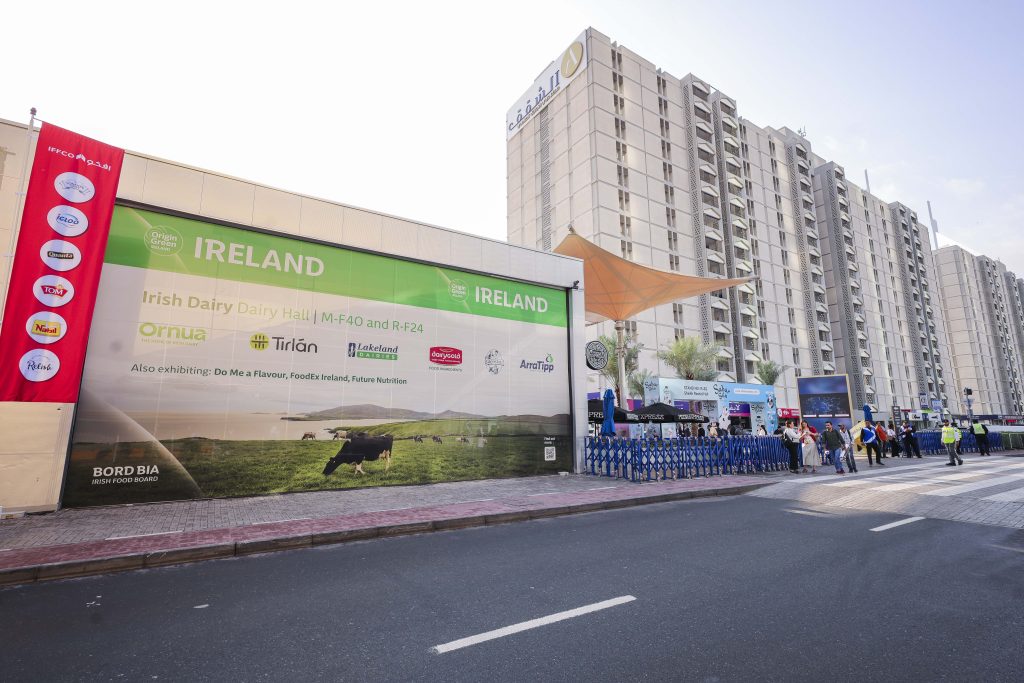
Bord Bia promotes the Irish dairy industry at the Gulfood Middle East trade show Source: Bord Bia
In this context, the Middle East overall remains, according to Bord Bia, a “strategically important market” for Irish food and drink exports.
It is estimated to be worth around €370 million – representing 11% year-on-year growth in 2025.
Bord Bia confirmed that dairy products still dominate Irish exports to the region and represent about 85% of the total value of exports.
But for Irish exporters specifically, one of the key trade impacts of the conflict in the Middle East relates to fresh and time-sensitive food categories.
The Middle East
The ongoing conflict and closure of the Strait of Hormuz, according to AHDB, also makes dairy exports to other regions in the Middle East such as Iraq, Kuwait, Bahrain, Qatar, the UAE and Saudi Arabia further east more difficult.
AHDB analysts now warn that global demand for dairy products “will remain weak given the current geopolitical scenario as consumers struggle with inflationary pressures”.
They predicted that “if the war continues for a longer period, it could have widespread impacts beyond the Middle East in terms of global consumer demand.”


