
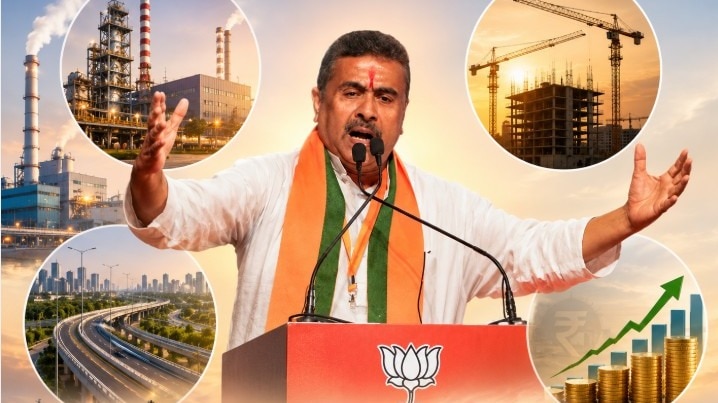
BJP leader Suvendu Adhikari He is set to take oath as West Bengal Chief Minister today at 11 am, marking a major political shift in the state following the BJP’s decisive victory in the 2026 Assembly elections. The result marks the end of nearly five decades of tense political dynamics of the central state in Bengal.
The new administration now faces the critical task of translating its electoral mandate into long-term economic recovery by addressing years of political stagnation, institutional weakness, and missed industrial opportunities.
The recent political shift in West Bengal could pave the way for a major revival of industry and infrastructure in the state, which could improve the growth prospects of many Bengal-related companies, JM Financial said.
BJP rule in West Bengal
In a strategy report released on May 8, the mediation highlighted that the BJP’s decisive victory in the 2026 West Bengal Assembly elections represents one of the biggest political changes in eastern India in decades, ending the Trinamool Congress’ 15-year rule. The report said that the size of the mandate could significantly improve the visibility of policy implementation and revive investor confidence in the country.
According to JM Financial, the BJP’s ‘Bhoroshar Shopoth’ manifesto outlines a manufacturing-led growth strategy that focuses on reviving manufacturing, logistics expansion, infrastructure creation, and investment promotion. The main proposals include setting up industrial parks in Singur, four major industrial zones, modern steel mills, defense manufacturing facilities, logistics hubs, deep sea ports, and expediting the completion of stalled metro and railway projects.
The brokerage believes these initiatives can support stronger manufacturing activity, infrastructure spending, and consumption growth in the medium term.
Companies to benefit
JM Financial has identified several companies that could benefit from the proposed development push. CESC could benefit from rising industrial and commercial electricity demand, while ITC could benefit from strong rural consumption and improved logistics infrastructure. Berger Paints could see increased demand from housing and infrastructure activities, while Texmaco Rail could benefit from rail modernization and logistics expansion.
The report also highlighted Chiam Metals as a potential beneficiary of the proposed focus on steel manufacturing, while Emami may benefit from stronger regional consumption trends and job generation measures.
Must read: He is Tamil Nadu’s ‘Vijay Sarkar’! TVK gets a score of 118 with VCK, CPI and CPM support
JM Financial compared the situation to what happened in Andhra Pradesh after the return of N. Chandrababu Naidu came to power when state-focused infrastructure-related companies witnessed a strong market re-rating amid expectations of faster project implementation and governance reforms.
The cultural identity of Bengal
The report comes amid a broader debate about the long-term economic trajectory and cultural identity of West Bengal. In his column titled ‘Renaissance Needed in East Again’, economist and writer Sanjeev Sanyal argues that Bengal’s economic decline cannot be explained solely by policy failure or industrial slowdown.
Before partition in 1947, undivided Bengal contributed about 10% to India’s GDP, and Kolkata served as one of the country’s leading centers for trade, industry, literature and science, Sanyal noted. However, over the decades, Bengal steadily lost its economic importance due to Partition-related unrest, socialist planning, anti-industrial policies, militant trade unions, and poor infrastructure development.
Must read: Why was Adani’s 1.6 GW Mahan Thermal Plant postponed to FY2028?
But Sanyal believes that economic explanations alone are insufficient. According to him, “the roots of Bengali identity have been systematically torn out,” creating what he described as an “intellectual, social and cultural vacuum.”
He further wrote that this disconnect from Bengal’s cultural and historical roots contributed to “political anarchism, mindless corporatism, militant student activism, and dead thought.”
Beyond investment and infrastructure
Sanyal said Bengal’s revival requires more than just investment inflows and governance reforms. He believes that long-term economic recovery depends on rebuilding cultural self-confidence and reconnecting with the nation’s historical strengths in entrepreneurship, education, literature, and intellectual leadership.
“It is time to reclaim its civilizational identity,” he wrote, adding that Bengal and Kolkata must “rise again” by rediscovering the cultural foundations that once made the region prosperous and globally influential.


