


author
Ahmed Balaha
author

Share


The price of Brent crude oil rose to $116 per barrel on March 30, 2026 – a 60% monthly rise driven by escalating tensions between the US and Iran after Tehran accused Washington of preparing for an invasion, exacerbating the unrest of Houthi strikes, and Bitcoin is now in the crosshairs of the risk-on resulting institutional rotation.
The rise in oil prices is not hitting cryptocurrencies directly; It hits it through three compounding channels: re-accelerating inflation, delaying Fed rate cuts, and a geopolitical risk premium that saps long exposure across every risky asset class.
Bitcoin fell to weekly lows between $63,000 and $65,700, and more than $500 million in derivatives were liquidated, 84% of which came from long positions.
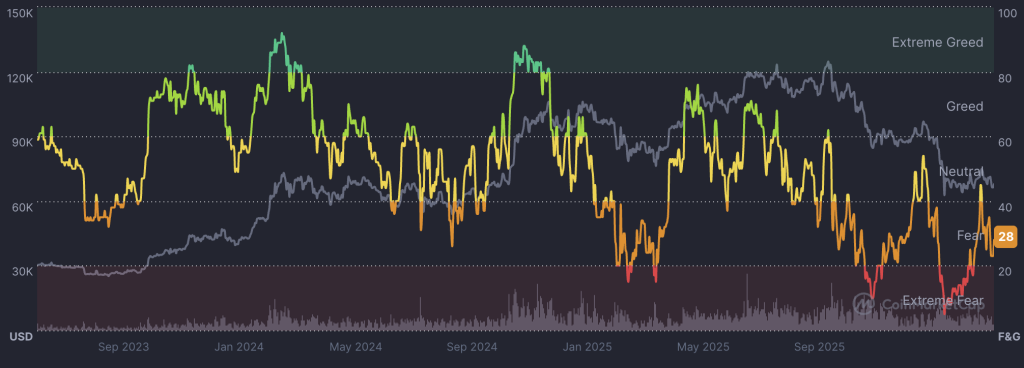
The Fear and Greed Index collapsed to 28 – extreme fear – while a record $14 billion options expiration amplified volatility.
Discover: The best cryptocurrencies to diversify your investment portfolio
Bitcoin faces structural deleveraging as oil-driven inflation rewrites the Fed’s rules of the game
$63,000 is a line that Bitcoin cannot afford to lose.
This level capped the downtrend during the previous two total shock episodes. The 200-day moving average is just below $62,400.
A close below it would be the first since the rally began in October 2025, and will likely trigger a second wave of systematic deleveraging from quantitative funds running momentum strategies. Resistance above is at $67,500 and $71,000, both former support areas that flipped during the February sell-off.
The oil correlation is more important than usual at the moment. Binance Research places the correlation between Bitcoin and WTI near zero in most market systems.
The 30-day rolling correlation is currently only 0.15. But this changes during extreme disturbance events. Oil flows into the Strait of Hormuz at about four million barrels per day, compared to 20 million in normal conditions. This is not a tail risk. This is an active structural shock to supply, and exactly the kind that results in temporary spikes in correlation.
If US-Iran tensions ease and Hormuz flows return to normal, Brent crude will fall below $100, and the Fed signals patience at its April 1-2 meeting. Bitcoin recovers $67,500, BlackRock’s IBIT builds on its $225.2 million inflow during the decline, and institutional rotation returns to accumulation mode.
If tensions continue without a full escalation, Brent will stabilize at $110-116 and the Fed will remain hawkish during the second quarter. Bitcoin price ranges between $63,000 and $68,000 with volatility high, ETF flows remain volatile, and mining costs for operators like Marathon Digital rise by 15 to 25%.
A complete siege of Hormuz is a scenario no one wants to price out. Oil topped $130, 10-year Treasury yields topped 5%, and the Fed was forced to choose between fighting inflation and supporting growth.
This combination could send Bitcoin to $55,000 to $57,000 in a full risk-off liquidation wave, mirroring February 2022 when WTI reached $115 and Bitcoin fell from $45,000 to $39,000 in days.
The inflation channel is what most traders underweight. The continuation of oil above $100 does not only put pressure on sentiment. It mechanically delays interest rate cuts.
Bitcoin’s price drop below $67,000 coupled with rising Treasury yields has already shown how directly this correlation is affecting it. BTC’s correlation of 0.9 to the IGV technology index means it is trading as a short-term rate-sensitive growth asset, rather than an inflation hedge.
Watch the Fed meeting April 1-2. Any language that suggests waiting longer is the catalyst for the next step down. Congressional votes on sanctions against Iran, expected in mid-April, are equally important. Further disruption of the Strait of Hormuz results in another shock across energy markets and directly impacts institutional risk appetite.
Discover: The best pre-launch token sales


