

Listen to the audio version of this article (generated by artificial intelligence).
UAE Leaves OPEC… What Does It Mean for Volatility?… POET Collapses by 50%… Did It Take Earnings?… OpenAI Struggles with Revenue… Will It Generate Enough to Meet Its Compute Obligations?
The United Arab Emirates announced this morning that it will exit OPEC on May 1, ending nearly six decades of membership and dealing one of the most significant blows to the organization in its history.
The UAE was the third largest producer in OPEC before the Iranian war disrupted shipping in the Gulf. Her departure strips the group of about 12% of its total supplies. More importantly, it removes one of the only two members – besides Saudi Arabia – with significant excess productive capacity.
As for the impact, here’s Jorge León, head of geopolitical analysis at Rystad Energy and former OPEC secretariat official:
The long-term implication is that OPEC is structurally weak.
Outside the group, the UAE will have the incentive and ability to increase production, raising broader questions about the sustainability of Saudi Arabia’s role as the central stabilizer in the market.
The timing of this morning’s news does not appear to be a coincidence for two reasons…
First, this announcement comes just days before the OPEC+ meeting scheduled for next Sunday, where members are set to begin negotiating production quotas for next year. Exiting now means the UAE will not be bound by a new quota framework by 2027 – which is consistent with the second reason…
The war in Iran has closed the Strait of Hormuz to most exports, but the UAE can transport more than half its oil overland, bypassing the blockade entirely. So, as Saudi Arabia, Iraq and other countries watch their exports choked by the war and cannot easily get oil to market regardless of their quotas, the UAE could potentially export more – but OPEC rules will not allow it.
This exit allows Abu Dhabi to continue its ambition to reach 5 million barrels per day of energy by 2027 without requesting permission from Riyadh.
As for the impact on oil prices, here is veteran trader Jonathan Rose Masters in Commerce: Live:
The UAE’s decision represents a break in the global oil export system at one of the most fragile moments in years.
Volatility will rise quickly as traders reprice expectations for supply, regional alliances, and what’s next for crude oil.
Refineries have remained strong so far. But this leadership may not hold if the market begins to shift to a new energy narrative.
This morning Masters in Trading Live episode, Jonathan reviewed the implications of the UAE’s decision, how it could reshape energy trading, and key stocks and sectors in a better position to weather the next wave of volatility. You can watch it for free here.
Bottom line: OPEC’s structural weakness represents a long-term headwind to oil price management. We will continue to track the implications for the evolving energy picture.
Now, let’s switch gears but stick with Jonathan…
While he spent this morning pointing out new energy opportunities, yesterday his subscribers were reminded that knowing when to get out is just as important as knowing when to get in…
“Take your winnings or someone else will take them for you.”
American financier Bernard Baruch is credited with this line. Yesterday, some traders who ignored this advice learned it the hard way.
The stock in question is Poet Technologies Inc. (poet) – A small semiconductor company designs optical engines to transmit data using light instead of copper wires.
As AI data centers grow larger and faster, the heat and power limitations of copper create a bottleneck. POET has built technology to solve this problem, putting the company directly in the path of one of the strongest demand forces in the market.
normal digest Readers know this story well.
In our February 12 digestwe defined POET as a business idea from veteran Jonathan Rose, editor Masters in Commerce: Live. By late last week, this trade had returned nearly 170% since we highlighted it.
But also last week, we noticed that Jonathan recommended his subscribers to take profits.
From his trade alert on Friday:
POET Technologies has now pushed the stock to levels not seen in over a decade, capping a move that has been nothing short of vertical.
As much as I like this stock over the long term, when a move like this falls into your lap, you don’t ask questions, you get profits.
We will look for more opportunities for POET in the future.
Then he came yesterday..
POET collapsed 47% after management reported this Marvell technology (MRVL) I have canceled all orders from Celestial AI – A company owned by the main client of Marvell and POET.
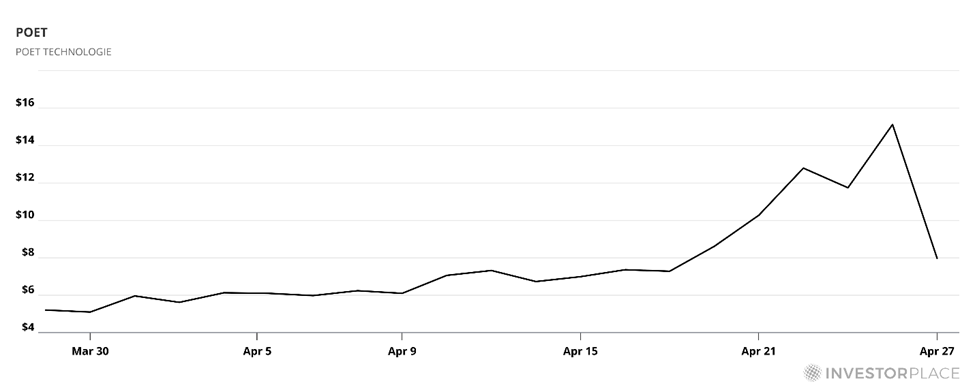
Marvell accused POET of breaching confidentiality obligations by disclosing the matter publicly. With the most important customer relationship gone, POET collapsed by nearly half in one sitting.
Momentum-chasing traders who bought from Jonathan’s subscribers last Friday are now sitting on losses that require almost 100% gains just to break even.
This is an important reminder about how professionals manage trades – even ones that seem unstoppable.
Jonathan saw the signs—a narrative-driven rally, sentiment outpacing fundamentals, a stock spillover—and protected his subscribers’ gains before the story unfolded. The merchants who chased POET were caught in a frenzy without a plan.
Being part of a vertical movement is exhilarating. But discipline is what gets you out before it becomes someone else’s buying opportunity.
Bottom line: Take your winnings, or someone else will take them for you.
To follow Jonathan’s daily comments and market analysis, Click here to join for free Masters in Commerce: Live videosEvery day the market is open.
Finally, the AI monetization gap is becoming harder to ignore
normal digest Readers know we’ve been pursuing a question that most Wall Streeters were happy to postpone…
Does end-user spending on AI justify the staggering sums being pumped into design?
Back in March, we flagged the sudden shutdown of OpenAI’s Sora video generation model as an early warning…
Downloads have collapsed by 75% from their peak. OpenAI was spending $15 million a day to run it. Even Bill Peebles, head of Sora at OpenAI, admitted that “the economy is completely unsustainable right now.”
We called it “Exhibit A” in the gap between building and monetizing AI.
Then yesterday digestwe framed what to watch in Big Tech earnings this week — specifically, whether hyper-volume revenue signals will show that consumer and enterprise spending on AI is finally catching up with the bets on infrastructure being made on their behalf.
Good, Wall Street Journal We just published a report that sits right in the middle of everything we’ve been tracking.
According to Wall Street JournalOpenAI missed its internal goal of reaching 1 billion weekly active ChatGPT users by the end of the year… Missed its annual revenue target after Google’s Gemini took market share… And missed multiple monthly revenue targets earlier this year after losing out to Anthropic in the Programming and Enterprise space.
That’s a lot of misses for a company sitting on $600 billion in future spending commitments.
At the same time, the company has also suffered from subscriber defection rates.
But the most troubling details are what’s happening internally.
here Wall Street Journal:
CFO Sarah Friar told other company leaders that she was concerned that the company might not be able to pay for future computing contracts if revenues didn’t grow fast enough.
The article notes that OpenAI has signed up for so much computing power that it expects to burn $122 billion in the next three years, assuming it meets its ambitious revenue goals.
But these revenue targets have not actually been met.
This is exactly the dynamic we flagged. The AI infrastructure layer is generating real revenue today. But the consumer-facing application layer – where the math ultimately has to end – remains woefully unproven.
To be clear: None of this means that AI business is over, or that AI in general will no longer generate revenue. But the question has never been whether AI will work or get many customers. It’s about whether it will operate and be profitable at a scale and speed that justifies the expenditure – before the money runs out.
Right now, the people closest to the numbers at OpenAI seem to be asking the same question we are.
We’ll continue to track that – and we’ll bring you the key takeaways from this week’s big tech earnings later this week.
I wish you a good evening,
Jeff Remsburg
Note: Want to know how to turn $100,000 into $1.3 million?
Today is your last day to learn how.
Last week, Keith Kaplan, CEO of TradeSmith, held his conference Artificial intelligence signals trading event Where he explained how a new form of artificial intelligence works Double your wallet By detecting the most profitable trades, 90 minutes before they happen.
As part of this, Keith demonstrated how this AI turned $100,000 into $1.3 million in its 5-year backtest through bull and bear markets. In the past year alone, it has achieved overall gains of 124%.
All it takes is just 10 minutes a week, says Keith.
Today is the last day we make A free relay of Keith’s show is available.


